What Is Real Estate Business? How It Works, Types, and Revenue Sources
Published: 26 Sep 2026
The real estate business is one of the largest and most diverse business sectors in the world. It involves activities connected with buying, selling, developing, leasing, managing, and marketing properties. These properties can include homes, apartments, offices, retail buildings, warehouses, industrial facilities, land, and other types of real property.
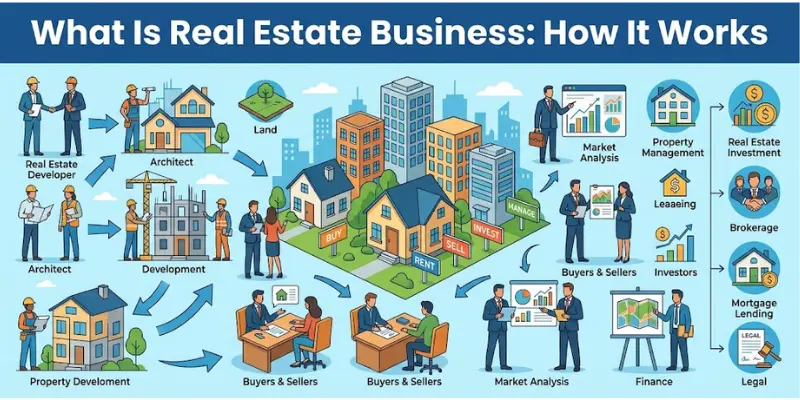
Unlike simply owning a property, running a real estate business involves providing a service, developing property, facilitating transactions, managing assets, or generating income from real estate activities. Real estate professionals may work as agents, brokers, developers, property managers, consultants, investors, or leasing specialists.
Understanding what is real estate business can help people who are considering a career in the industry, starting a property-related company, or learning how real estate generates revenue. The business can range from a small agency helping people buy and sell homes to large companies developing commercial projects and managing extensive property portfolios.
What Is Real Estate Business?
Real estate business refers to commercial activities involving real property and the services associated with it. It can include property transactions, real estate development, leasing, property management, brokerage, marketing, consulting, and investment-related activities.
Real estate itself generally refers to land and the buildings or improvements permanently attached to it. The business side of real estate focuses on how individuals and companies create value from these assets and the services surrounding them. A useful general explanation of real estate and its major categories is available from Investopedia’s real estate guide.
For example, a real estate agency may earn a commission by helping a buyer purchase a home. A developer may purchase land, construct a building, and sell or lease the completed units. A property management company may earn fees for managing rental properties on behalf of owners.
Therefore, the real estate business is broader than buying and selling houses. It includes many professional activities that support the creation, transaction, operation, and management of property.
How Does Real Estate Business Work?
The real estate business works through different participants who perform specific functions during the property lifecycle. A typical transaction may involve a property owner, buyer, seller, real estate agent, broker, lender, lawyer, surveyor, property inspector, developer, or property manager.
In a sales transaction, the property owner generally wants to find a suitable buyer and complete the transaction under agreed terms. A real estate agent may market the property, arrange viewings, communicate with potential buyers, negotiate terms, and assist with the transaction process.
A broker may supervise agents or operate a brokerage business. Depending on local laws, brokers may also have additional responsibilities relating to transactions, licensing, contracts, and compliance.
In property development, the process is different. A developer may identify an opportunity, acquire land or an existing property, arrange financing, obtain required approvals, coordinate construction, market the project, and sell or lease the completed property.
Property management follows another model. The owner retains ownership while a management company handles responsibilities such as tenant communication, rent collection, maintenance coordination, inspections, and other operational tasks.
These different activities demonstrate why real estate business can involve both physical property and professional services.
Main Types of Real Estate Business
There are several major business models within the real estate industry. Some companies specialize in one area, while larger organizations may operate across several segments.
Real Estate Brokerage
Real estate brokerage is one of the most recognizable real estate business models. Brokerage companies connect buyers and sellers or landlords and tenants and assist them throughout transactions.
The business generally earns revenue through commissions or other agreed fees. The exact commission structure and legal requirements vary by location.
Real Estate Development
Real estate development involves transforming land or existing properties into projects that can be sold, leased, or otherwise used commercially.
A developer may build residential communities, apartment buildings, offices, shopping centers, warehouses, hotels, or mixed-use developments. Development requires significant planning, financing, construction management, market research, and risk management.
Property Management
Property management businesses provide operational services to property owners. Their responsibilities may include finding tenants, collecting rent, coordinating maintenance, handling tenant communication, and monitoring properties.
Owners who do not want to manage their properties personally may hire professional managers. You can learn more about this area through What Is Property Management?.
Real Estate Leasing
Leasing businesses and professionals help property owners find tenants and negotiate rental arrangements. Leasing can cover residential homes and apartments as well as offices, retail units, warehouses, and other commercial properties.
Depending on the agreement, the business may earn a leasing fee, commission, management fee, or recurring service revenue.
Real Estate Consultancy
Real estate consultants provide information and professional advice to clients. Their work may involve market research, property selection, feasibility analysis, valuation support, development planning, or commercial property advice.
Consultancy can be especially useful for businesses and investors making decisions involving significant property assets.
Real Estate Marketing
Real estate marketing involves promoting properties to potential buyers, tenants, or investors. Traditional methods include signs, brochures, property listings, newspapers, and direct marketing. Modern methods increasingly include websites, social media, search engines, property portals, email marketing, photography, video, and virtual tours.
Marketing can be performed by an internal team, an independent marketing agency, or a specialized real estate professional.
How Do Real Estate Businesses Make Money?
Real estate businesses can generate revenue in several ways. The exact model depends on the company’s activities and the type of property involved.
Commissions
Agents and brokers may receive commissions when they successfully facilitate property transactions. The amount and structure depend on the transaction and local market practices.
For example, an agent may represent a seller and help market and sell a property. If the transaction is completed, the agent or brokerage may receive an agreed commission.
Management Fees
Property management companies commonly charge owners a management fee for providing ongoing services. The fee structure can depend on the property type, services provided, rental income, and agreement between the parties.
Rental Income
Property owners can generate recurring revenue by leasing properties to tenants. Residential apartments, houses, offices, retail spaces, warehouses, and industrial facilities can all produce rental income.
More detailed information about investment properties and their income potential can be found in Investment Property: Complete Guide.
Development Profits
Developers can earn revenue by selling completed properties or leasing them to occupants. The potential return depends on factors such as acquisition cost, construction expenses, financing costs, market conditions, selling prices, and operating expenses.
Consulting Fees
Consultants may charge clients for professional advice, market research, feasibility studies, property analysis, or other specialized services.
Leasing and Service Fees
Businesses involved in leasing, marketing, administration, or property-related services may charge fixed fees, commissions, or recurring payments depending on their contracts.
Real Estate Business vs Real Estate Investment
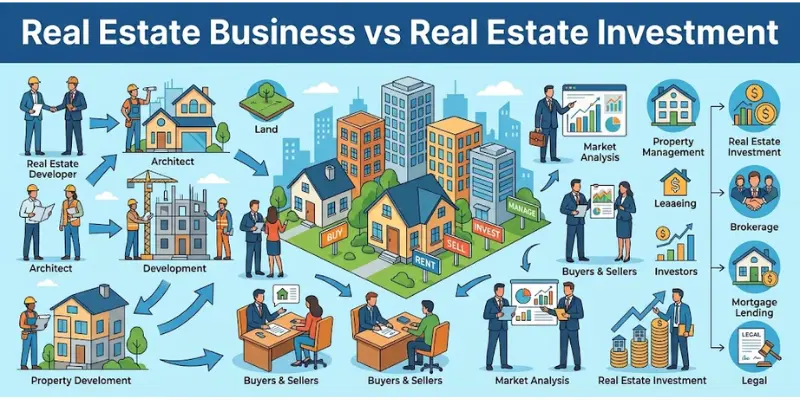
Real estate business and real estate investment are related but are not exactly the same.
A real estate investor primarily acquires or holds property with the objective of generating income, preserving capital, or benefiting from changes in property value. An investor may own a rental property without operating a real estate company.
A real estate business, on the other hand, may provide services to property owners and buyers without owning significant property itself. For example, an agency can operate as a real estate business while earning commissions from transactions.
A person can also combine both approaches by owning investment properties while operating a brokerage, development, or property management business.
Main Areas of Real Estate Business
Real estate businesses operate across several property sectors.
Residential Real Estate
Residential real estate includes properties designed primarily for people to live in, such as houses, apartments, condominiums, and other residential units.
Businesses operating in this segment may focus on sales, rentals, property management, development, or marketing. For more information about residential property, see What Are Residential Properties?.
Commercial Real Estate
Commercial real estate includes properties used for business activities. Examples include office buildings, retail stores, shopping centers, restaurants, and other commercial spaces.
Businesses in this sector often deal with larger transactions and longer lease agreements than many residential transactions.
Industrial Real Estate
Industrial properties support manufacturing, production, storage, distribution, and logistics activities. Warehouses, distribution centers, factories, and specialized industrial facilities can fall into this category.
The demand for industrial property can be influenced by manufacturing activity, logistics networks, transportation infrastructure, and business expansion.
Land
Land is another major part of the real estate business. Companies and individuals may buy, sell, develop, lease, or hold land for future use.
Land transactions require careful consideration of location, zoning, access, infrastructure, development restrictions, and potential future use.
Role of a Real Estate Agent
A real estate agent acts as an intermediary between parties involved in property transactions. Depending on the transaction, an agent may represent a buyer, seller, landlord, or tenant.
Common responsibilities include finding potential clients, preparing property listings, arranging viewings, communicating with clients, marketing properties, negotiating terms, and helping coordinate the transaction.
Agents need strong communication, negotiation, customer service, market knowledge, and organizational skills.
The exact licensing requirements for agents differ between jurisdictions, so anyone planning to enter the profession should understand the rules that apply in their local market.
Role of a Real Estate Broker
A real estate broker generally operates at a broader professional or business level than an individual agent. In many markets, brokers can manage agents, operate brokerage companies, supervise transactions, and handle additional responsibilities.
Brokerage businesses may generate revenue from commissions earned through transactions completed by the company and its professionals.
A broker may also build a team of agents and create systems for marketing, lead generation, transaction management, and customer service.
Role of a Real Estate Developer
A developer takes responsibility for creating or transforming property projects.
The development process can begin with identifying suitable land or an existing property. The developer then evaluates the project’s feasibility, financing requirements, regulatory conditions, construction costs, expected demand, and potential revenue.
After acquiring or controlling the property, the developer may coordinate architects, engineers, contractors, lenders, lawyers, marketers, and other professionals.
Development can create significant economic opportunities, but it also involves substantial financial and operational risks.

Factors That Affect the Real Estate Business
The performance of a real estate business can be influenced by many factors.
Location
Location is one of the most important considerations in real estate. Accessibility, infrastructure, employment opportunities, schools, transportation, commercial activity, and neighborhood development can affect property demand.
Economic Conditions
Employment levels, business activity, interest rates, inflation, consumer confidence, and access to financing can influence property transactions and demand.
Supply and Demand
When demand increases while available property remains limited, prices or rents may increase. Conversely, excess supply can place pressure on prices and rental rates.
Interest Rates and Financing
Many property transactions depend on financing. Changes in borrowing costs can affect affordability for buyers and financing costs for developers and investors.
Government Regulations
Planning rules, zoning requirements, taxes, property laws, building regulations, licensing requirements, and other government policies can affect real estate businesses.
Market Competition
Real estate companies compete for clients, properties, tenants, development opportunities, and market share. Strong customer service and effective marketing can help a business establish its position.
Benefits of Starting a Real Estate Business
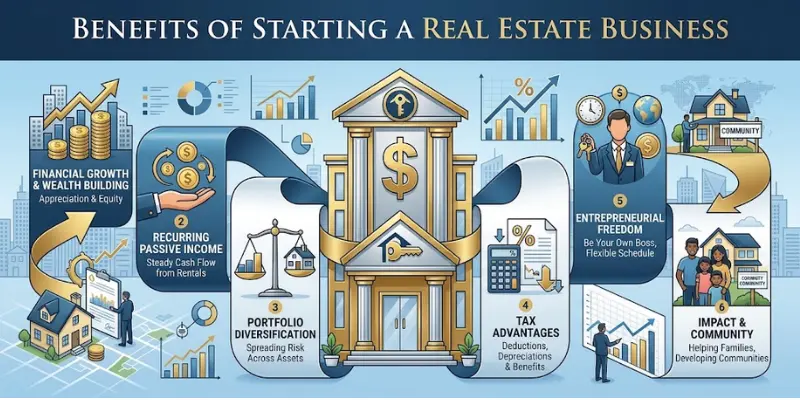
A real estate business can provide several opportunities for entrepreneurs and professionals.
One advantage is the variety of business models available. A person can work in brokerage, property management, consulting, marketing, development, leasing, or related services.
Real estate can also provide opportunities for recurring revenue. Property management, leasing, rental operations, and other services may generate ongoing income when supported by appropriate contracts and customer relationships.
Another potential benefit is scalability. A small agency can gradually expand its team, geographic coverage, property portfolio, or service range.
The industry also creates opportunities for specialization. Professionals may focus on residential sales, commercial property, industrial facilities, luxury property, land, investment property, or property management.
Risks in the Real Estate Business
Real estate businesses also face risks and challenges.
Market conditions can change, affecting property values, transaction volumes, rental demand, and development activity.
Cash-flow management is another important concern. Businesses may have ongoing expenses even when transactions are slow.
Developers face additional risks related to construction costs, financing, approvals, project delays, contractor performance, and changes in market demand.
Real estate professionals also depend heavily on reputation and client relationships. Poor communication, inaccurate information, weak service, or failure to meet contractual obligations can damage a business.
Legal and regulatory compliance is equally important. Property transactions can involve contracts, taxes, licensing requirements, ownership documents, zoning rules, and other legal matters. Businesses should obtain appropriate professional advice when required.
How to Start a Real Estate Business
Starting a real estate business requires planning and a clear understanding of the market.
Choose a Business Model
The first step is deciding what type of real estate business you want to operate. Options may include brokerage, property management, development, leasing, consulting, marketing, or property investment.
Research the Local Market
Study property prices, rental rates, demand, competitors, customer requirements, development activity, and available opportunities.
A clear understanding of the local market can help a new business identify the type of clients and properties it wants to serve.
Understand Legal Requirements
Real estate businesses are subject to local laws and regulations. Depending on the jurisdiction and business model, licensing, registration, taxation, contracts, and professional requirements may apply.
These requirements should be checked with the relevant local authorities or qualified professionals before starting operations.
Create a Business Plan
A business plan should outline the target market, services, operating model, expected costs, revenue sources, marketing strategy, staffing requirements, and financial goals.
Build a Professional Brand
A professional identity can help establish trust with customers. This can include a business name, website, professional property listings, social media presence, contact systems, and consistent communication.
Develop a Marketing Strategy
Property businesses depend heavily on visibility and lead generation. Online listings, websites, social media, email marketing, search engines, referrals, networking, and traditional advertising can all contribute to customer acquisition.
Build a Network
Successful real estate businesses often work with a wide network of professionals, including lenders, lawyers, contractors, architects, inspectors, photographers, property managers, and other agents.
Strong professional relationships can help businesses serve clients more effectively.
Technology in the Real Estate Business
Technology has changed how real estate businesses operate.
Websites and property portals allow businesses to display listings to large audiences. Digital photography and video can help potential buyers or tenants understand properties before arranging physical visits.
Virtual tours and online communication can also make property marketing more convenient.
Customer relationship management systems can help businesses organize leads, follow up with prospects, track transactions, and maintain customer information.
Data analysis can assist professionals in studying prices, rental trends, demand, and market activity.
Digital document management and electronic communication can also reduce administrative work and make transactions easier to coordinate.
Skills Needed for a Real Estate Business
Different real estate roles require different skills, but several abilities are valuable across the industry.
Communication is essential because professionals regularly interact with buyers, sellers, landlords, tenants, developers, contractors, and other stakeholders.
Negotiation skills are important when discussing prices, commissions, rental agreements, contracts, and transaction terms.
Market research skills help professionals understand property values, customer demand, competition, and market trends.
Financial understanding is also valuable. Professionals should be able to understand costs, revenue, cash flow, financing, and basic property economics.
Marketing and digital skills can help businesses generate leads and promote properties effectively.
Finally, organization and attention to detail are important because real estate transactions can involve substantial documentation, deadlines, contracts, and financial commitments.
Is Real Estate Business Profitable?
The profitability of a real estate business depends on its business model, location, costs, market conditions, competition, customer demand, and management.
A brokerage may generate income through commissions, while a property management company may depend on recurring management fees. Developers may generate substantial revenue from completed projects, but they also face significant upfront costs and risks.
Profitability should therefore not be assumed simply because property values are high. A business must manage operating expenses, marketing costs, staff costs, financing, taxes, technology, and other expenses.
A sustainable real estate business generally requires consistent customer acquisition, good financial management, reliable service, and an understanding of the market in which it operates.
Property Management and Real Estate Business
Property management is one part of the wider real estate industry. A property management company may operate without owning the properties it manages.
Its role is to provide services to owners, such as tenant management, rent collection, maintenance coordination, inspections, and administrative support.
Some real estate companies combine brokerage and property management services. Others specialize exclusively in management.
For businesses interested specifically in this field, Real Property Management provides additional information about property management activities.
Future of the Real Estate Business
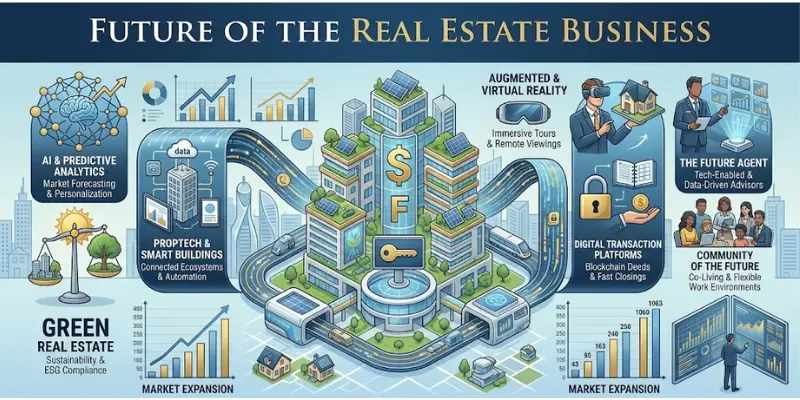
The real estate industry continues to evolve as technology, consumer behavior, urban development, financing, and economic conditions change.
Digital property searches are becoming increasingly important, allowing customers to research properties before contacting agents.
Data-driven decision-making is also becoming more common. Businesses can use property databases, market reports, customer information, and digital analytics to improve planning and marketing.
Sustainability and energy efficiency are also receiving increasing attention in property development and management. Developers and property owners may consider energy use, building materials, environmental performance, and operating costs when planning projects.
At the same time, personal relationships remain important. Buying, selling, leasing, or developing property can involve significant financial decisions, so customers often value professional guidance and reliable communication.
Frequently Asked Questions About Real Estate Business
What is real estate business in simple words?
Real estate business is the business of providing services or conducting commercial activities related to property. It can include buying, selling, leasing, developing, marketing, managing, or advising on real estate.
What are the main types of real estate business?
Major types include real estate brokerage, property development, property management, leasing, consulting, marketing, and property investment.
How does a real estate business make money?
A real estate business can earn money through commissions, management fees, rental income, consulting fees, leasing fees, marketing services, or profits from property development and sales.
Is real estate business the same as real estate investment?
No. Real estate investment generally involves owning or acquiring property to generate income or benefit from potential value changes. A real estate business can provide professional services such as brokerage or property management without owning property.
Can I start a real estate business without owning property?
Yes. Some real estate businesses provide services rather than owning properties. Brokerage, consulting, marketing, leasing, and property management are examples.
What does a real estate agent do?
A real estate agent helps clients with property transactions. Responsibilities can include marketing properties, finding buyers or tenants, arranging viewings, communicating with clients, negotiating terms, and helping coordinate transactions.
What does a property manager do?
A property manager handles operational responsibilities for property owners. These may include tenant communication, rent collection, maintenance coordination, inspections, and administrative tasks.
What skills are important in real estate business?
Communication, negotiation, market research, financial understanding, marketing, customer service, organization, and knowledge of local property regulations are useful skills.
Is real estate business risky?
Like other businesses, real estate involves risks. Market changes, financing costs, competition, regulatory requirements, construction expenses, vacancies, and cash-flow problems can affect performance.
Can technology help a real estate business?
Yes. Websites, property portals, digital marketing, CRM systems, virtual tours, online communication, data analysis, and digital document management can improve marketing and business operations.
Final Thoughts
The real estate business is a broad industry that extends far beyond buying and selling houses. It includes brokerage, development, property management, leasing, consulting, marketing, and other professional activities connected with real property.
The business model a company chooses determines how it operates and generates revenue. Some businesses earn commissions from transactions, while others generate recurring management fees, rental income, consulting fees, or development revenue.
Success in real estate requires more than knowledge of property prices. Professionals need to understand customers, market conditions, financing, regulations, marketing, negotiation, and business management.
For entrepreneurs and professionals interested in the industry, the first step is to choose a specific area of real estate, understand the local market, meet all applicable legal requirements, and build a business model around a genuine customer need. With careful planning, professional service, and responsible financial management, a real estate business can become a sustainable long-term enterprise.

Is Real Estate a Good Investment in India? Benefits, Risks, Market Trends & Expert Analysis (2026 Guide)





- Be Respectful
- Stay Relevant
- Stay Positive
- True Feedback
- Encourage Discussion
- Avoid Spamming
- No Fake News
- Don't Copy-Paste
- No Personal Attacks
- Be Respectful
- Stay Relevant
- Stay Positive
- True Feedback
- Encourage Discussion
- Avoid Spamming
- No Fake News
- Don't Copy-Paste
- No Personal Attacks
