How to Get a Real Estate License in New York: Requirements, Costs & Steps
Published: 03 Nov 2026
Starting a career in the real estate industry can create opportunities to work with homebuyers, sellers, property investors, and commercial clients. However, before professionally assisting people with property transactions, you generally need to obtain the appropriate state license. If you are interested in entering this industry, understanding how to get a real estate license in New York is an important first step.
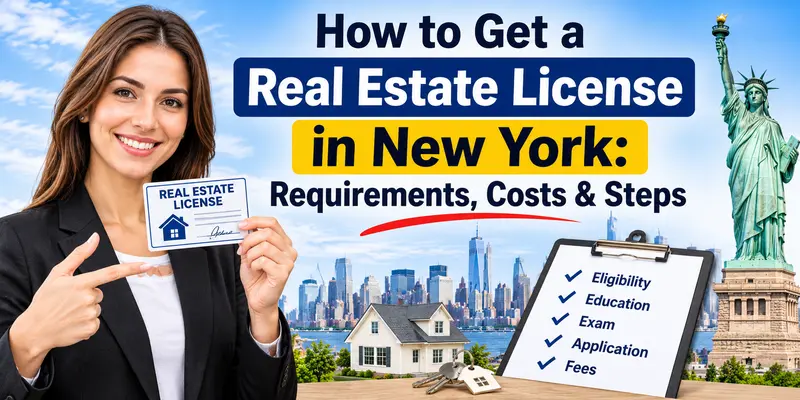
A real estate agent helps clients buy, sell, or rent properties while following applicable licensing laws. Before choosing this career, it is useful to understand what a real estate agent does and the professional responsibilities involved in property transactions.
New York has specific licensing requirements for individuals who want to work as real estate salespersons. Applicants must meet the state’s eligibility requirements, complete approved pre-licensing education, pass the licensing examination, and obtain sponsorship from a licensed real estate broker. The process also involves submitting an application and paying the required fees to the New York State Department of State.
Whether you want to work in New York City, Brooklyn, Queens, Buffalo, Albany, or Rochester, the basic salesperson licensing requirements are generally the same. However, choosing an appropriate real estate school, preparing for the examination, and finding a sponsoring broker can influence how smoothly you complete the process.
This guide explains how to get a real estate license in New York, including its definition, meaning, eligibility requirements, education options, examination process, licensing costs, and practical examples. It also explains what happens after receiving your license and how you can begin building a professional career.
What Is a Real Estate License in New York?
A real estate license in New York is an official authorization issued by the New York State Department of State that allows qualified individuals to perform regulated real estate activities under the state’s licensing laws. It confirms that an applicant has fulfilled the applicable education, examination, and other legal requirements for a licensed real estate position.
In simple terms, a real estate license gives an eligible individual permission to work professionally in the real estate industry within the scope of their license. For example, a licensed salesperson can assist clients with property transactions while working under the supervision of their sponsoring real estate broker.
To understand the broader concept, you can also explore what real estate means and how property ownership, sales, and leasing work.
The meaning of a New York real estate license is particularly important for people who want to earn commissions by helping buyers and sellers complete property transactions. Individuals generally cannot independently perform activities requiring a salesperson or broker license without the appropriate authorization.
New York has different licensing levels, including salesperson and broker licenses. A salesperson typically begins their career by working with an established brokerage, whereas a broker can qualify to operate a brokerage business and supervise other licensed professionals.
You can review the official requirements through the New York Department of State.
How to Get a Real Estate License in New York: Step-by-Step Process
If you want to understand how to get a real estate license in New York, the most practical approach is to follow the state’s licensing process in the correct order. The following steps explain what aspiring real estate salespersons generally need to complete.
Step 1: Meet the New York Real Estate License Requirements
Before enrolling in a pre-licensing course, check whether you meet the state’s basic eligibility requirements. New York requires applicants for a salesperson license to be at least 18 years old when applying.
The Department of State also requires applicants to have a current New York State photo driver’s license or non-driver identification card. Additionally, applicants must complete the required qualifying education, pass the state salesperson examination, and obtain sponsorship from a New York State licensed real estate broker.
The main requirements include:
- Be at least 18 years old.
- Complete 77 hours of approved qualifying real estate education.
- Pass the New York State Real Estate Salesperson Examination.
- Obtain sponsorship from a New York licensed real estate broker.
- Have a current NYS photo driver’s license or non-driver ID card.
- Submit the required application and licensing fee.
An important point is that New York does not generally require applicants to have previous professional real estate sales experience for an initial salesperson license.
For example, someone who has worked in retail, customer service, banking, or another industry can consider becoming a real estate salesperson without first having professional experience selling houses.
However, applicants should review the Department of State’s current requirements and individual circumstances before applying. The official New York real estate salesperson licensing page provides authoritative eligibility information.
Step 2: Complete the Required 77-Hour Real Estate Pre-Licensing Course
The next important step is completing the approved 77-hour pre-licensing course. New York requires aspiring salespersons to complete qualifying education through an approved education provider.
This course introduces students to the knowledge and responsibilities involved in real estate transactions. It helps beginners understand property ownership, real estate laws, agency relationships, contracts, financing, and professional responsibilities.
The curriculum covers several important subjects, including:
- Real property and property ownership.
- Real estate brokerage and agency relationships.
- Property valuation and market analysis.
- Real estate contracts and agreements.
- Mortgage financing and real estate mathematics.
- Land use regulations and environmental considerations.
- Fair housing laws and discrimination.
- Property management.
- Real estate transactions and professional practices.
Completing this education is important because the state examination is based on the approved pre-licensing curriculum. Students should focus on understanding the subjects rather than simply memorizing examination answers.
For instance, a student learning about agency relationships should understand the responsibilities of a real estate salesperson toward buyers, sellers, and the supervising broker. Similarly, learning about contracts helps students recognize the legal responsibilities involved in property transactions.
You can explore the approved education providers through the New York Department of State.
Step 3: Choose an Approved New York Real Estate School
Choosing an appropriate real estate school can make your licensing journey easier. Several education providers offer New York real estate classes, including online and classroom-based learning options.
Before enrolling, verify that the school is approved to provide the required New York salesperson qualifying course. Do not assume that every online real estate course satisfies the state’s licensing requirements.
When comparing schools, consider the following factors:
- State approval and course recognition.
- Online and classroom learning options.
- Course materials and practice examinations.
- Instructor support and student assistance.
- Tuition and additional examination fees.
- Course completion policies.
- Availability of flexible study schedules.
Some students prefer traditional classroom instruction because they can interact directly with instructors and other learners. Others choose approved distance-learning education because it allows them to study around existing work and family responsibilities.
For example, someone working a full-time job in New York City may prefer an approved online course that offers flexible study sessions. A student who learns better through direct interaction may prefer attending in-person real estate classes.
You can explore providers such as the New York Real Estate Institute (NYREI) and Fordham University’s Real Estate Institute. Always verify the current course approval and availability before paying tuition.
Licensing rules differ between states. If you are also interested in another state’s process, you can read our guide on how to get a real estate license in Florida.
Step 4: Pass the Required Course Examination
After completing the 77-hour pre-licensing education, students must also satisfy the education provider’s school-administered proctored examination requirement.
This examination is separate from the New York State licensing examination. Passing the school examination does not automatically mean that you have passed the state examination.
The school examination evaluates your understanding of the subjects covered during the qualifying course. You should review your study materials, practice real estate mathematics, and understand the major legal concepts before attempting the examination.
For example, questions may test your understanding of property ownership, agency relationships, contracts, fair housing, or commission calculations.
If you do not pass the school examination, check your education provider’s retake policies and follow its instructions. Once you successfully complete the required course examination, you can move forward with the state licensing examination process.
Step 5: Schedule and Pass the New York Real Estate Salesperson Exam
Passing the New York State Real Estate Salesperson Examination is another essential part of obtaining your license.
Applicants must create or access an account through eAccessNY. This online system allows eligible candidates to apply for examinations, schedule appointments, review examination details, and check results.
The state examination is based on the 77-hour pre-licensing curriculum. It is a multiple-choice examination, and candidates are allowed 1.5 hours to complete it.
The examination fee is currently $15.
Before scheduling your examination, make sure you have completed the required education and have the information needed to register through your eAccessNY account.
Preparation should include reviewing important real estate terminology, property ownership, contracts, agency relationships, financing, fair housing, and state-specific regulations.
For example, a candidate may encounter questions about how a salesperson should handle a buyer’s offer or the responsibilities associated with representing a property seller.
Candidates must bring acceptable, current government-issued photo identification and the examination confirmation information specified by the Department of State. Acceptable identification includes certain state-issued IDs, a US passport, and other approved documents.
The examination result is reported as either passed or failed rather than as a numerical score. A passing examination result remains valid for two years.
For current examination information, visit the official NYS Real Estate Salesperson licensing page.
Step 6: Find a Sponsoring New York Real Estate Broker
After completing the required education and examination, you must obtain sponsorship from a New York State licensed real estate broker.
This requirement is important because a real estate salesperson does not operate independently in the same way as a licensed broker. A salesperson works under the supervision of their sponsoring or representative broker.
A sponsoring broker provides the professional and regulatory supervision required for the salesperson’s licensed activities. The broker also authorizes the salesperson’s initial license application through the state’s online licensing system.
When searching for a brokerage, consider its training programs, commission structure, transaction support, professional reputation, and opportunities for new agents.
For example, a newly qualified salesperson may join a residential real estate brokerage in Brooklyn. The broker can provide guidance about property listings, client communication, showing procedures, purchase offers, and transaction documentation.
Another applicant might prefer joining a brokerage in Albany or Buffalo because of its local property market and available training opportunities.
Before committing to a brokerage, ask about new-agent training, mentorship, commission arrangements, marketing support, lead-generation opportunities, and professional supervision.
You can learn more about the responsibilities and services of a real estate broker, including how brokers supervise agents and manage property transactions.
You do not need to have a sponsoring broker simply to start your pre-licensing education or take the examination. However, sponsorship is required for the initial salesperson license application.
Step 7: Submit Your Real Estate License Application Through eAccessNY
Once you have fulfilled the required qualifications and secured broker sponsorship, you can proceed with your initial salesperson license application.
New York uses the eAccessNY system for eligible online applications. Applicants should create an account or sign in to their existing account and select the appropriate initial salesperson licensing option.
The application process generally involves providing personal information, confirming your qualifying education, and identifying your sponsoring broker.
Your principal broker must also access their own account and authorize your application. After authorization, the Department of State reviews the application to determine whether you satisfy the licensing requirements.
The initial salesperson application fee is currently $65.
Make sure your application information is accurate and that your education documentation and other required details are complete. Incorrect or missing information can delay processing.
You can access the New York eAccessNY licensing portal to begin the applicable online process.
Step 8: Receive Your New York Real Estate Salesperson License
After the Department of State reviews and approves your application, your real estate salesperson license can be issued.
The state indicates that an approved license will be mailed to your business address. Your sponsoring broker must also have completed the required authorization.
Once your license is active, you can begin performing permitted real estate salesperson activities under your broker’s supervision.
For example, you may assist buyers in finding residential properties, arrange property showings, communicate with prospective clients, and help facilitate transactions within the scope of your license.
However, obtaining a license is only the beginning of your professional journey. Developing market knowledge, communication skills, negotiation abilities, and strong client relationships is equally important for long-term success.
How Much Does It Cost to Get a Real Estate License in New York?
The cost of obtaining a New York real estate salesperson license depends on the education provider you choose and any additional expenses associated with your professional preparation.
The two main state fees are the initial application fee and the written examination fee. According to the New York Department of State, the current fees are:
| Licensing expense | Current fee |
|---|---|
| Initial salesperson application | $65 |
| State written examination | $15 |
| Total state fees | $80 |
These figures do not include pre-licensing course tuition, study materials, or other optional expenses.
For example, if an approved real estate school charges $300 for its 77-hour course, your estimated initial expense would be $380, including the $80 in state fees. This is only an illustrative calculation, not a quoted school tuition price.
You should also consider possible expenses associated with joining a brokerage, including training, technology, marketing, professional memberships, and transaction-related costs.
It is important to distinguish between state licensing fees and the total cost of starting a real estate career. The $80 covers the two listed state fees, not every expense involved in becoming a working real estate salesperson.
You can verify the latest fees through the New York Department of State’s official licensing information.
Can You Get a New York Real Estate License Online?
Yes. You can complete the required pre-licensing education through an approved online or distance-learning course if the provider and course meet New York State requirements.
Online education is a convenient option for people who cannot regularly attend traditional classroom sessions. It allows students to study from home, review course materials, and organize their learning schedules around work or other responsibilities.
However, there is an important difference between completing your education online and obtaining your entire license online.
The licensing process includes several separate requirements:
- Complete the approved 77-hour pre-licensing course.
- Pass the school’s required proctored examination.
- Pass the New York State salesperson examination.
- Obtain sponsorship from a licensed New York broker.
- Submit the initial license application and required fee.
The state examination must be scheduled through eAccessNY, and candidates must follow the Department of State’s examination arrangements.
For example, a student living in Queens can complete an approved distance-learning pre-licensing course while working full-time. After completing the education requirements, the student can schedule the state examination, find a sponsoring broker, and submit the application through the appropriate online system.
Therefore, online learning can make the educational part of obtaining a New York real estate license more flexible, but it does not eliminate the remaining licensing requirements.
How Long Does It Take to Get a Real Estate License in New York?
The time required to obtain a New York real estate license depends on how quickly you complete the education, pass the examinations, secure broker sponsorship, and receive application approval.
The state requires 77 hours of qualifying pre-licensing education. However, completing those hours does not necessarily mean you will receive your license immediately.
Your overall timeline can include:
- Completing the 77-hour course.
- Preparing for and passing the school examination.
- Scheduling and passing the state examination.
- Finding a sponsoring real estate broker.
- Completing the application process.
- Waiting for the Department of State to review your application.
For example, a student who studies consistently and completes the course quickly may be ready to take the state examination sooner than someone studying only on weekends.
However, another applicant may need additional time to prepare for the examination or find a suitable brokerage.
There is no single guaranteed completion timeline for every applicant. It is better to plan around your education schedule, examination availability, and application processing rather than relying on an advertised completion promise from a real estate school.
What Is the Difference Between a New York Real Estate Salesperson and Broker License?
Understanding the difference between a salesperson and broker license is important before entering the real estate industry.
Both are professional licenses, but they have different eligibility requirements, responsibilities, and levels of professional independence.
A real estate salesperson works under the supervision of a licensed representative broker. Salespersons can assist clients with real estate transactions, but their licensed activities must be conducted through their sponsoring brokerage.
A real estate broker has additional qualifications and responsibilities. Brokers may operate a brokerage business, supervise salespersons, and perform the activities permitted under their broker license.
| Comparison | Salesperson license | Broker license |
|---|---|---|
| Minimum age | 18 years | 20 years |
| Qualifying education | 77 hours | 152 hours |
| Experience | No prior professional sales experience required | Generally, 2 years as a licensed salesperson or 3 years of qualifying general real estate experience |
| State examination | Required | Required |
| Broker sponsorship | Required | Not required in the same salesperson relationship |
| Main role | Works under a representative broker | Can operate and supervise a brokerage |
For example, someone entering the real estate industry for the first time will generally pursue a salesperson license. After gaining the required experience and completing additional education, that individual may qualify to apply for a broker license.
New York requires broker applicants to meet additional experience, education, examination, and application requirements. You can review the details on the Department of State’s broker licensing page.
How to Get a Real Estate License in NYC
New York City does not issue a separate general real estate salesperson license that replaces the New York State license.
Instead, individuals who want to work as real estate salespersons in New York City must satisfy the applicable New York State licensing requirements.
This means the basic process is the same whether you want to work in Manhattan, Brooklyn, Queens, the Bronx, or Staten Island.
You must complete the 77-hour qualifying course, pass the state examination, obtain sponsorship from a licensed New York broker, and submit the appropriate application.
However, working in NYC can involve additional professional challenges because the property market is diverse and competitive. New agents may need to understand apartment rentals, condominium sales, cooperative housing, residential purchases, commercial properties, and local market conditions.
For example, a salesperson working in Manhattan may primarily assist clients searching for condominiums and rental apartments. Another agent in Queens may focus on single-family houses and multifamily properties.
Although the state licensing requirements remain consistent, developing knowledge of your chosen neighborhood can help you build a stronger real estate career.
Can You Transfer an Out-of-State Real Estate License to New York?
If you already hold a real estate license in another state, you should not automatically assume that it allows you to practice in New York.
New York does not currently have general real estate license reciprocity with other states. Therefore, holding a license in New Jersey, Florida, California, or another state does not automatically authorize you to perform licensed real estate activities in New York.
However, individuals who completed qualifying education outside New York may submit a written request for an education waiver. The Department of State reviews the education and supporting documentation to determine whether the applicant qualifies.
Applicants who receive an education waiver must still pass the New York State salesperson examination and follow the applicable application process.
For example, a salesperson licensed in New Jersey who wants to work with clients in New York should contact the New York Department of State before accepting a position involving licensed real estate activities in New York.
You can review the state’s real estate salesperson licensing requirements and official salesperson FAQs for guidance about your circumstances.
What Happens After You Get Your New York Real Estate License?
Receiving your license is an important achievement, but it is the beginning of your professional career rather than its final stage.
Once your license is active, you can start working under your sponsoring broker and developing the practical skills required to assist real estate clients.
One of your first priorities should be understanding your brokerage’s policies, commission arrangements, transaction procedures, and professional responsibilities.
You should also become familiar with the local property market. Studying neighborhood prices, rental trends, property types, and comparable sales can help you communicate more effectively with prospective buyers and sellers.
Building a professional network is another important step. Relationships with mortgage professionals, property inspectors, attorneys, other agents, and potential clients can help you develop business opportunities.
Consider the following practical activities:
- Learn how your brokerage manages property listings.
- Understand how to arrange property showings.
- Develop effective communication and negotiation skills.
- Learn how purchase offers and transaction documents are handled.
- Build a professional online presence.
- Understand fair housing and advertising requirements.
- Maintain good relationships with clients and colleagues.
For example, a newly licensed salesperson in Buffalo might begin by assisting experienced agents with residential showings and buyer inquiries. Over time, the salesperson can develop local market knowledge and build a client base.
If you want to explore the wider professional opportunities available in the industry, you can also read how to become a real estate agent.
Similarly, understanding what a real estate business involves can help you identify opportunities beyond residential property sales.
How to Renew a New York Real Estate Salesperson License
Obtaining a New York real estate license also involves ongoing responsibilities. A salesperson must maintain an active license to continue performing activities that require licensure.
New York salesperson licenses generally have a two-year renewal cycle. Licensees must complete the applicable continuing education requirements and submit their renewal applications and fees before their licenses expire.
The Department of State currently requires 22.5 hours of approved continuing education for applicable real estate licensees. Required subjects include cultural competency, implicit bias, ethical business practices, recent legal matters, fair housing, and agency-related education.
There is a special agency-education rule for the initial two-year salesperson licensing term: two hours of agency-related instruction must be completed within the two-year period immediately preceding renewal.
For example, an established salesperson approaching their second renewal should check the continuing education hours required for that particular renewal period and complete the necessary courses before submitting the application.
One important point is that New York does not provide a grace period that allows an individual to continue performing licensed activities after their license expires.
You can review the latest New York real estate salesperson continuing education requirements.
Practical Examples of Getting a Real Estate License in New York
Understanding the licensing process becomes easier when you consider how different applicants might approach it.
Example 1: A beginner starting a real estate career in Brooklyn
Suppose an individual living in Brooklyn wants to become a residential real estate salesperson. The applicant is 25 years old and has no previous experience in real estate.
They enroll in an approved 77-hour course, complete the required education and school examination, and pass the New York State salesperson examination.
Next, they find a sponsoring broker in Brooklyn and submit their application through eAccessNY. After the Department of State approves the application, they can begin working under their broker’s supervision.
Example 2: A full-time employee studying online in Queens
Consider someone working in an office who wants to transition into real estate. Attending classroom sessions may be difficult because of their daily work schedule.
They choose an approved online pre-licensing course and complete the required 77 hours while continuing their existing job.
After satisfying the education requirements, they prepare for the state examination, secure a sponsoring broker, and submit their application.
This example shows how online education can help people pursue a real estate career without immediately leaving their current employment.
Example 3: An experienced New Jersey salesperson moving to New York
Imagine a real estate salesperson who already holds an active New Jersey license but wants to work with clients in New York.
The individual should first contact the New York Department of State to determine whether their previous education qualifies for a waiver or whether additional education requirements apply.
They should not assume that a New Jersey license automatically authorizes them to perform licensed real estate activities in New York.
These examples demonstrate that although the basic licensing process is consistent, an applicant’s education, experience, and professional circumstances can affect the steps they need to follow.
Frequently Asked Questions About Getting a Real Estate License in New York
1. How do I get a real estate license in New York?
To obtain a New York real estate salesperson license, you must be at least 18 years old, complete an approved 77-hour pre-licensing course, pass the school examination and state salesperson examination, obtain sponsorship from a licensed New York broker, and submit your application and required fee to the Department of State.
2. How much does a real estate license cost in New York?
The New York State initial salesperson application fee is $65, and the written examination fee is $15. Therefore, the combined state fees are $80. Pre-licensing course tuition and other professional expenses are additional.
3. Can I get a real estate license in New York online?
You can complete your 77-hour pre-licensing education online through an approved provider. However, you must also satisfy the school examination requirement, pass the state examination, obtain broker sponsorship, and complete the licensing application process.
4. How many hours of education are required for a New York real estate license?
New York requires 77 hours of approved qualifying education for a salesperson license. Applicants must also satisfy the education provider’s proctored examination requirements before proceeding with the state licensing examination.
5. Do I need a college degree to become a real estate salesperson in New York?
A college degree is not a general requirement for obtaining a New York real estate salesperson license. Applicants must meet the state’s age, education, examination, identification, and broker sponsorship requirements.
6. Can I become a real estate agent in NYC without experience?
Yes. New York does not generally require previous professional real estate sales experience for an initial salesperson license. Beginners can enter the industry by completing the required education, passing the state examination, and obtaining broker sponsorship.
7. How much is the New York real estate salesperson examination?
The current state examination fee is $15. Candidates must schedule their examination through the eAccessNY system and follow the Department of State’s examination instructions.
8. How long is a New York real estate license valid?
A New York real estate salesperson license generally follows a two-year renewal cycle. Licensees must satisfy the applicable continuing education and renewal requirements to maintain an active license.
9. Can I get a New York real estate license if I live in another state?
Living outside New York does not automatically prevent someone from applying. However, applicants must satisfy New York’s licensing requirements. New York does not have general reciprocity with other states, although qualifying out-of-state education may be considered for a waiver.
10. What is the difference between a real estate salesperson and a broker in New York?
A salesperson works under the supervision of a licensed representative broker. A broker has additional education and experience requirements and may operate a brokerage and supervise other licensed real estate professionals.
Conclusion
Understanding how to get a real estate license in New York can help you prepare for a career in one of the country’s major property markets. Although the licensing process involves several requirements, following the correct steps can make the journey more manageable.
Start by confirming your eligibility and enrolling in a New York State-approved 77-hour pre-licensing course. Complete the required school examination, prepare for the state salesperson examination, and find a suitable sponsoring broker. After meeting these requirements, submit your application through the appropriate Department of State licensing system.
Remember that obtaining your license is only the beginning. Developing market knowledge, learning professional practices, building client relationships, and maintaining your continuing education are important parts of a successful real estate career.
For more property-related information, investment guidance, and real estate insights, explore Grand Real Estates. You can also learn more about the website and its educational purpose on our About Us page.

- Be Respectful
- Stay Relevant
- Stay Positive
- True Feedback
- Encourage Discussion
- Avoid Spamming
- No Fake News
- Don't Copy-Paste
- No Personal Attacks
- Be Respectful
- Stay Relevant
- Stay Positive
- True Feedback
- Encourage Discussion
- Avoid Spamming
- No Fake News
- Don't Copy-Paste
- No Personal Attacks
