How to Get a Real Estate License in South Carolina: Requirements, Costs & Steps
Published: 16 Nov 2026
Getting a real estate license in South Carolina can open the door to a rewarding career in residential sales, commercial property transactions, and other real estate services. Whether you want to help families find their first homes, work with property investors, or build a long-term career in the property industry, obtaining the appropriate state license is an important first step.
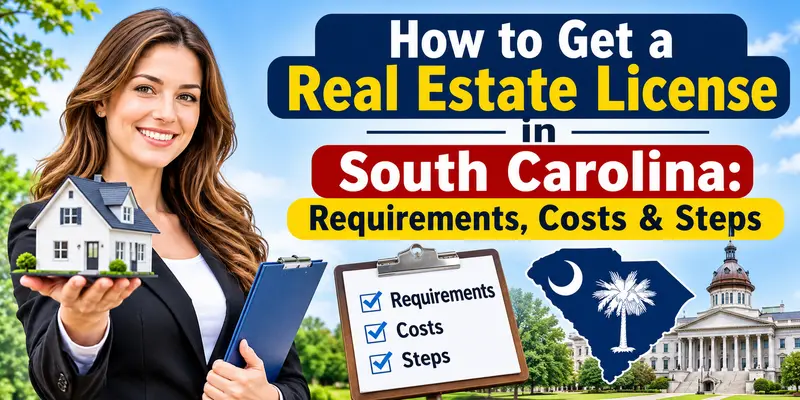
South Carolina regulates real estate professionals through the South Carolina Real Estate Commission, which operates under the South Carolina Department of Labor, Licensing and Regulation (LLR). Applicants must satisfy the state’s eligibility requirements, complete the required pre-licensing education, submit an application, undergo a background check, and pass the licensing examination.
The process may seem complicated for first-time applicants, particularly when you need to understand education hours, application procedures, examination requirements, and licensing costs. However, breaking the process into manageable steps makes it easier to understand what you need to do and when.
This guide explains how to get a real estate license in South Carolina, from checking your eligibility and choosing an approved real estate school to completing the licensing process and finding a sponsoring broker. It also covers estimated expenses, license verification, renewal requirements, and frequently asked questions to help you make informed decisions before starting your real estate career.
What Is a South Carolina Real Estate License?
A South Carolina real estate license is a state-issued professional authorization that allows qualified individuals to perform regulated real estate activities, such as assisting clients with buying, selling, and negotiating property transactions.
The license is regulated by the South Carolina Real Estate Commission (SCREC), which operates under the South Carolina Department of Labor, Licensing and Regulation (LLR). The Commission establishes licensing standards, approves education providers, administers regulatory requirements, and oversees licensed real estate professionals.
For someone entering the industry, the first license is generally called an Associate License. An associate works under the supervision of a South Carolina-licensed Broker-in-Charge (BIC). This means a newly licensed professional cannot independently operate a real estate brokerage simply because they have passed the licensing examination.
For example, imagine someone wants to help homebuyers purchase residential properties in Charleston. Before providing services that require a real estate license, that individual must complete the required qualifications, obtain an associate license, and work under the supervision of an eligible broker.
The licensing process is designed to ensure that real estate professionals understand property ownership, contracts, financing, state regulations, professional responsibilities, and consumer protection.
If you are exploring different state licensing routes, you may also read our guides on how to get a real estate license in Florida and how to get a real estate license in New York. Each state establishes its own licensing rules, so requirements should not be assumed to be identical.
South Carolina Real Estate License Requirements
Before beginning the application process, you should confirm that you meet the basic eligibility requirements for an associate license. South Carolina has established minimum age, educational, background-check, and examination requirements for applicants.
The following table summarizes the main qualifications for a standard first-time applicant.
| Requirement | South Carolina condition |
|---|---|
| Minimum age | 18 years |
| General education | High school diploma or recognized equivalent |
| Unit I education | 60 hours |
| Unit II education | 30 hours |
| Total pre-licensing education | 90 hours |
| Background screening | Fingerprint-based and Social Security number checks |
| Examination | National and state portions |
| Professional supervision | South Carolina licensed Broker-in-Charge |
These requirements are based on the Commission’s Associate License Requirements and Application Process document. SCLLR+1
Minimum age requirement
You must be at least 18 years old to qualify for a South Carolina associate real estate license. Applicants who have not reached this age do not meet the standard eligibility requirements.
High school diploma or equivalent
You must have graduated from high school or possess an equivalent qualification recognized by the appropriate US education authorities.
If you completed your education outside the United States, the Commission may require an educational equivalency evaluation. Its guidance identifies credential evaluation organizations such as the National Association of Credential Evaluation Services (NACES) and the Association of International Credential Evaluators (AICE).
Required pre-licensing education
Most applicants must complete 90 hours of Commission-approved real estate education. This consists of a 60-hour Fundamentals of Real Estate course and a 30-hour Advanced Real Estate Principles course.
Background screening
Applicants must complete the Commission-required fingerprint-based criminal history check and Social Security number check. The Commission provides instructions after receiving the application.
Licensing examination
You must pass the required national and South Carolina state examination portions unless an applicable examination exemption applies.
Broker supervision
To practice with an active associate license, you must work under the supervision of a South Carolina-licensed Broker-in-Charge.
Applicants should review the official South Carolina Real Estate Commission requirements before enrolling in a course or submitting an application.
How to Get a Real Estate License in South Carolina: Step-by-Step
Understanding the licensing requirements is important, but knowing the order of the application, education, examination, and supervision steps makes the process easier to manage.
Here is a practical explanation of how to get a real estate license in South Carolina.
Step 1: Check Your Eligibility
Start by confirming that you satisfy the state’s minimum age and educational requirements. You should also review the Commission’s application instructions to determine which documents you need.
Prepare the following documents and information where applicable:
- Valid driver’s license, state-issued identification, passport, or military identification.
- Signed Social Security card.
- High school diploma, GED certificate, or qualifying official college transcript.
- Proof of residency using the requested identification documentation.
- Notarized verification of lawful presence.
- Legal documents supporting a name change, if applicable.
- Personal history disclosures and supporting explanations, if required.
- Previous real estate license verification, if you have held a license elsewhere.
Nonresident applicants may also need to complete a Consent to Jurisdiction and Service of Process form.
The Commission’s application package identifies specific documents that must be notarized. Its current online application instructions state that pages 4 and 6 of the required documentation must be notarized. Always use the latest application package rather than an older downloaded copy. SCLLR+1
For example, if you recently moved to South Carolina and want to enter the real estate industry, collect your identification, educational records, and other requested documents before starting the application. This can help reduce delays caused by missing information.
Step 2: Complete the 60-Hour Unit I Fundamentals Course
The first major educational requirement is completing Unit I, known as Fundamentals of Real Estate. This course provides the foundation for understanding how the property industry operates and introduces the principles that real estate professionals use in everyday transactions.
The 60-hour course generally covers subjects such as:
- Real property ownership and property rights.
- Land descriptions and property characteristics.
- Real estate brokerage relationships.
- Agency and professional responsibilities.
- Property valuation and market analysis.
- Real estate contracts and agreements.
- Financing and mortgage principles.
- Real estate mathematics.
- Property management fundamentals.
- Applicable real estate laws and regulations.
For example, a student learning about property ownership may study the differences between sole ownership, joint ownership, and other legal forms of holding property. Understanding these concepts helps future agents explain transactions and recognize issues that may require professional legal advice.
Unit I is also important preparation for the national and state licensing examination.
Make sure that the course is approved by the South Carolina Real Estate Commission. An educational course accepted in another state does not automatically satisfy South Carolina’s licensing requirements.
Step 3: Apply for a South Carolina Real Estate License
Once you have reviewed the eligibility requirements and prepared your documents, you can begin the associate licensing application.
The Commission provides an online application process through its official licensing system. Applicants must complete the required documentation, upload the requested records, and pay the application fee to submit the application.
The process generally involves:
- Downloading or printing the latest application documents.
- Completing the required forms.
- Arranging notarization of the designated pages.
- Uploading the completed documentation.
- Providing educational and identification records.
- Answering personal history questions accurately.
- Paying the nonrefundable application fee.
The Commission currently allows up to 30 days to complete the online application submission. After the application has been fully submitted, applicants generally have one year to provide all required outstanding information. SCLLR+1
You can begin through the South Carolina LLR Online Application Portal.
It is important to distinguish between submitting an application and receiving approval to take the examination. Paying the application fee does not automatically make you eligible to schedule the PSI test.
Step 4: Complete the Fingerprinting and Background Checks
South Carolina requires applicants to complete two background checks:
- Fingerprint-based background check.
- Social Security number background check.
These checks help the Commission evaluate the applicant’s eligibility and verify the information provided in the licensing application.
One important detail is that applicants should not arrange the background-check process before receiving instructions from the Commission. The Commission sends the relevant information after receiving the application.
Applications cannot be approved until both background reports have been received and reviewed. SCLLR
If you have previously been convicted of an offense, received disciplinary action from another licensing authority, or have another matter requiring disclosure, answer the application questions truthfully.
A previous legal or disciplinary issue does not necessarily produce the same outcome in every case. The Commission may request additional documents, explanations, or other information before making its decision.
Step 5: Obtain Authorization to Take the Licensing Examination
After reviewing your application and required information, the South Carolina Real Estate Commission will notify eligible applicants when they can proceed to the examination stage.
The state uses PSI Services LLC to administer its real estate licensing examinations.
You should wait for the official examination eligibility notification before attempting to register with PSI. According to the current PSI Candidate Information Bulletin, examination eligibility remains valid for one year. Applicants must pass both required portions within that period. PSI Exams
After receiving authorization, allow the stated system-processing period before trying to schedule your examination. The Commission’s online guidance advises applicants to allow 48 hours for the examination authorization to transfer into PSI’s system.
You can find examination instructions and registration information through the PSI South Carolina Real Estate Testing Portal.
Step 6: Complete the 30-Hour Unit II Advanced Real Estate Principles Course
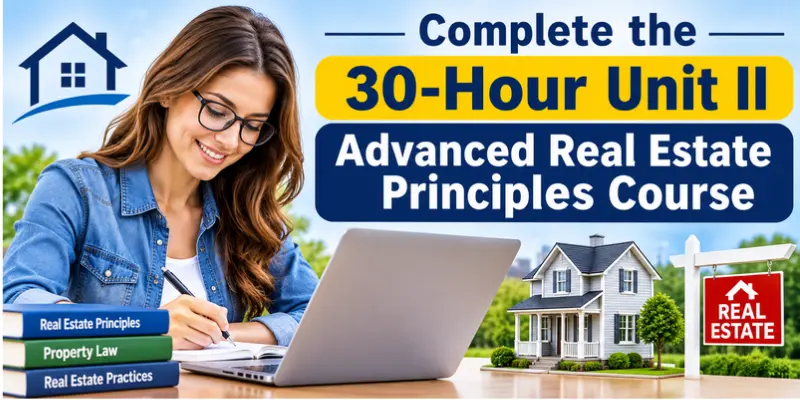
Unit II is the second part of the standard pre-licensing education requirement. It consists of 30 hours of Advanced Real Estate Principles.
This course builds on the knowledge introduced in Unit I and helps students develop a deeper understanding of real estate transactions, professional responsibilities, and the legal framework governing the industry.
Subjects may include:
- Advanced real estate principles.
- Brokerage operations and professional responsibilities.
- Real estate transactions and contracts.
- Agency relationships and disclosure obligations.
- Property-related legal issues.
- State regulations and compliance.
- Practical applications of real estate knowledge.
The Commission’s current associate application instructions explain that applicants receive an email outlining the remaining steps, including completion of Unit II and submission of the course certificate.
An important point is that Unit II may be submitted after the examination, subject to the Commission’s instructions. Therefore, follow the sequence and deadlines stated in your individual application correspondence rather than assuming both course certificates must be uploaded at the same time. SCLLR+1
Once you complete Unit II, retain your certificate and submit it through the document-submission process specified by the Commission.
Step 7: Pass the South Carolina Real Estate Licensing Exam
Passing the licensing examination is one of the most important requirements for obtaining an associate license.
The examination is administered by PSI and contains two sections:
- National portion.
- South Carolina state portion.
Applicants must pass both portions to satisfy the standard examination requirement.
According to the PSI Candidate Information Bulletin updated January 1, 2026, the associate examination has the following structure:
| Exam section | Questions | Time allowed |
|---|---|---|
| National | 80 | 120 minutes |
| South Carolina state | 40 | 80 minutes |
| Total | 120 | 200 minutes |
PSI Exams
The national section evaluates general real estate knowledge, while the state section focuses on South Carolina laws, regulations, and licensing-related requirements.
The examination may cover topics such as:
- Property ownership and land use.
- Real estate valuation.
- Contracts and agreements.
- Financing and mortgages.
- Brokerage relationships.
- Real estate mathematics.
- Property management.
- South Carolina real estate law.
- Fair housing and consumer protection.
- Professional responsibilities.
How to prepare for the exam
Start by reviewing the official PSI examination content outline. It identifies the subject areas and their relative importance in the examination.
You should also:
- Review the material from both pre-licensing courses.
- Practice real estate mathematics.
- Study South Carolina-specific laws and regulations.
- Take practice examinations.
- Review incorrect answers to identify knowledge gaps.
- Use the official PSI candidate bulletin for examination preparation.
The Commission’s FAQ also identifies AWARE in South Carolina as a commonly used study resource for the state law portion.
The purpose of preparation is not simply to memorize definitions. You should understand how real estate principles apply to practical situations involving buyers, sellers, brokers, property ownership, and contractual obligations.
For the latest scheduling instructions, fees, and examination rules, visit PSI’s official candidate information page.
Step 8: Find a Sponsoring Broker-in-Charge
Passing the examination does not automatically mean that you can begin practicing real estate independently.
South Carolina requires associate licensees to work under the supervision of an appropriately licensed Broker-in-Charge (BIC) to practice with an active license.
A Broker-in-Charge is responsible for supervising real estate activities conducted through the brokerage and helping ensure compliance with applicable state laws and professional standards.
When looking for a brokerage, consider the following:
- Training and mentoring opportunities.
- Commission-sharing arrangements.
- Transaction and administrative fees.
- Marketing support.
- Access to listing systems and technology.
- Professional development.
- Brokerage reputation and local market knowledge.
For example, a newly licensed associate in Greenville might choose a brokerage that provides structured training, guidance on residential transactions, and access to experienced professionals.
The Commission requires a completed Supervision Attestation Form as part of the final licensing process. If you do not identify an eligible brokerage and supervising BIC, your license may be issued in inactive status.
An inactive license does not authorize you to practice real estate. Once you arrange qualifying supervision, you can follow the Commission’s reactivation procedure. SCLLR+1
Step 9: Submit the Final Documents and Receive Your License
After passing the required examination and completing the outstanding education requirements, follow the Commission’s email instructions for submitting your final documentation.
The final process generally includes:
- Completing the Unit II course, if applicable.
- Completing the Supervision Attestation Form.
- Uploading the required documents through the Licensee Portal.
- Waiting for the Commission to review the submitted information.
- Receiving the initial licensing fee invoice.
- Paying the required initial license fee.
The Commission states that it sends a license issuance email after receiving and processing the initial licensing fee. Its current associate licensing instructions advise allowing approximately three to five business days for license issuance after fee processing. SCLLR
Once your license has been issued, verify its status and confirm that the brokerage information is correct.
Do not begin activities requiring an active license until your status has been confirmed as active.

How Much Does a South Carolina Real Estate License Cost?
The total cost of obtaining a South Carolina real estate license depends on several factors, including the education provider, application charges, examination fees, fingerprinting, and other related expenses.
The Commission publishes its licensing charges, while approved schools determine their own course prices. Therefore, the total amount can differ between applicants.
For a standard associate applicant, the currently published state charges include:
| Licensing expense | Fee |
|---|---|
| Associate application fee | $25 |
| PSI examination (both portions) | $63 |
| Initial associate license fee | $50 |
| Total listed state fees | $138 |
SCLLR+1
These amounts do not include education tuition, fingerprinting, background-check charges, or optional study materials.
Pre-licensing education cost
The 90-hour education requirement is usually one of the main expenses. Real estate schools offer different course packages, and prices may vary depending on whether you select online instruction, classroom learning, textbooks, or examination preparation.
Application fee
The standard associate application fee is $25. This payment is nonrefundable and nontransferable.
Examination fee
PSI currently charges $63 for both examination portions or $55 for one portion. These fees apply to the associate and broker examinations and are paid directly to PSI.
Initial license fee
The standard initial associate license fee is $50. Applicants qualifying through Georgia or North Carolina reciprocity have a reduced initial fee of $25.
Fingerprinting and background-check expenses
Applicants should budget for any applicable fingerprinting and background-check service charges. The actual amount should be confirmed using the instructions supplied by the Commission.
Other possible expenses
Some applicants also purchase additional examination preparation materials, practice tests, textbooks, or professional resources.
For accurate planning, calculate the total using your chosen school’s tuition and the current state charges. Do not assume that the $138 in listed state fees represents the complete cost of becoming a licensed real estate associate.
How Long Does It Take to Get a Real Estate License in South Carolina?
The time required to obtain a South Carolina real estate license depends on how quickly you complete the educational courses, submit your application, finish the background checks, pass the examination, and arrange broker supervision.
The state requires 90 hours of pre-licensing education for most standard associate applicants. However, the overall process does not have one guaranteed completion timeline for everyone.
Consider these main stages:
| Licensing stage | Time consideration |
|---|---|
| Unit I Fundamentals course | 60 required hours |
| Unit II Advanced course | 30 required hours |
| Application submission | Depends on document preparation |
| Background checks | Depends on completion and review |
| Examination scheduling | Depends on PSI availability |
| Final licensing | Depends on document and fee processing |
The Commission processes applications and documents in the order received. Its FAQ does not promise a fixed application-processing period.
There are also two important deadlines to remember:
- A completed application generally remains valid for one year, during which outstanding information must be submitted.
- Examination eligibility remains valid for one year after Commission approval.
These deadlines should not be confused with a guaranteed one-year licensing process. They are limits within which applicants must complete the relevant requirements. SCLLR+2
For example, a student who studies consistently, prepares documents in advance, completes the required education, and passes both examination portions on the first attempt may progress more quickly than someone who studies occasionally or needs additional attempts.
How to Find a South Carolina Real Estate License School

Choosing an appropriate educational provider is an important part of obtaining a South Carolina real estate license.
Because the state requires specific pre-licensing courses, you should choose a school that offers education approved by the South Carolina Real Estate Commission.
Applicants can generally choose between online and classroom-based instruction, depending on the available approved courses.
Online real estate schools
Online education is useful for students who want flexibility. You can study from home, organize your learning schedule, and review course materials according to your availability.
However, make sure that the specific course is approved for South Carolina licensing. A school offering real estate education for Florida, Georgia, or another state may not automatically satisfy South Carolina’s requirements.
Classroom-based real estate schools
Traditional classroom education allows students to interact directly with instructors and other learners. It may be helpful for people who prefer structured lessons, scheduled classes, and opportunities to ask questions.
What to consider before enrolling
Before selecting a South Carolina real estate license school, compare the following:
- Commission approval for Unit I and Unit II.
- Total tuition and additional charges.
- Online and classroom learning options.
- Course schedules and completion policies.
- Instructor qualifications.
- Study materials and examination preparation.
- Student support and course access.
- Availability of the required completion certificates.
You can check the Commission’s official Pre-Licensing Education and Approved Providers information before paying for a course.
It is also worth comparing the complete package rather than choosing a school based only on its advertised starting price.
South Carolina Real Estate License Lookup
After obtaining your license, you may want to verify your professional status or check another real estate professional’s credentials.
The South Carolina Real Estate Commission provides an online license verification facility through the LLR Licensee Lookup Tool.
The system can help users confirm whether a professional holds a South Carolina real estate license and review the available licensing information.
To use the South Carolina real estate license lookup:
- Visit the official South Carolina LLR Licensee Lookup.
- Enter the licensee’s first and last name or the requested license information.
- Follow the search instructions.
- Review the available licensing record.
- Confirm the license type and current status.
The Commission also advises individuals searching for their own license number to use their name in the lookup facility rather than entering unnecessary location information. SCLLR+1
Why is license verification important?
License verification is useful for several reasons:
- Buyers and sellers can check a real estate professional’s licensing information.
- Brokerage companies can verify credentials.
- Licensees can confirm their own license details.
- Consumers can identify whether a professional holds an appropriate license.
- Individuals can check available license status information before entering into professional relationships.
For example, a homebuyer in Columbia who wants to work with a real estate associate can use the official lookup facility to check the professional’s licensing record.
The South Carolina real estate license lookup is also useful when you need to verify your license number or check the status of a renewal or reinstatement.
South Carolina Real Estate License Reciprocity
Real estate licensing is generally regulated at the state level. Therefore, holding a license in one state does not automatically authorize you to practice in another.
However, South Carolina has established reciprocal licensing arrangements with two states:
- Georgia.
- North Carolina.
These arrangements allow qualifying licensees to apply for South Carolina licensure under specific conditions. The applicable education, examination, experience, and documentation requirements depend on the reciprocal agreement and the applicant’s existing license.
Georgia real estate license reciprocity
South Carolina has a reciprocal licensing agreement with Georgia. Eligible Georgia licensees may qualify for a South Carolina associate license without completing the standard additional education and examination requirements, provided they meet the agreement’s conditions.
The applicant must provide the required license certification and other supporting documents.
A Georgia applicant who qualifies for reciprocity is generally exempt from the South Carolina licensing examination under the applicable agreement.
North Carolina real estate license reciprocity
South Carolina also has a reciprocal agreement with North Carolina.
The requirements depend on the North Carolina license classification.
For example, a North Carolina broker may qualify to apply for a South Carolina associate license under the agreement. A North Carolina provisional broker must satisfy the applicable post-licensing or South Carolina education requirements and pass the South Carolina state examination.
Therefore, applicants should not assume that every North Carolina license holder receives the same exemptions.
What about Florida, California, and New York license holders?
South Carolina’s current reciprocal agreements are limited to Georgia and North Carolina.
A Florida, California, or New York real estate license does not automatically qualify its holder for South Carolina reciprocity.
The Commission’s general requirements explain that an applicant with an active license in another jurisdiction, or one that has not been expired for more than six months, may qualify for an examination exemption limited to the state portion. However, this does not automatically remove the standard education requirements.
The Commission’s FAQ identifies Georgia and North Carolina reciprocity and specified educational exemptions as the relevant exceptions to the standard education rules. SCLLR+3
For the latest details, consult the official South Carolina Real Estate Commission Reciprocity Information.
How to Renew a South Carolina Real Estate License
Obtaining a real estate license is an important professional achievement, but maintaining it requires ongoing attention to renewal deadlines and continuing education.
South Carolina has established renewal and continuing education requirements for active associate and broker licensees.
Continuing education requirements
Active associate licensees generally need to complete 10 hours of approved continuing education during each renewal cycle.
The required education consists of:
| Continuing education | Required hours |
|---|---|
| Mandatory core course | 4 |
| Elective courses | 6 |
| Total | 10 |
The education must be completed before submitting the renewal application unless an applicable exemption applies.
South Carolina uses CE Broker to track continuing education records. Approved education providers submit completed course information to the tracking system. SCLLR+1
Renewal fee
The currently published associate license renewal fee is $45.
The Commission also publishes different fees for brokers, Broker-in-Charge licenses, and other regulated license categories.
Renewal deadline
South Carolina’s real estate licensing renewal cycle operates on a biennial basis, with the relevant renewal period occurring during April through June of the expiration year.
You should check your individual license expiration date using the official LLR Licensee Lookup Tool.
What happens if you miss the renewal deadline?
A license that is not renewed by the applicable deadline becomes lapsed.
South Carolina generally allows a lapsed licensee 24 months from the expiration date to complete the reinstatement process, subject to the applicable requirements and fees.
A lapsed or canceled license does not authorize the individual to continue practicing real estate. SCLLR
For renewal instructions, fees, and continuing education information, visit the South Carolina Real Estate Commission Renewal Resource.
Common Mistakes to Avoid When Applying for a South Carolina Real Estate License
Although the licensing process has clearly defined steps, first-time applicants can encounter delays when they misunderstand the requirements or submit incomplete documentation.
Avoiding the following mistakes can help make your application more manageable.
Enrolling in an unapproved course
Not every real estate course satisfies South Carolina’s educational requirements. Before enrolling, confirm that the provider and specific Unit I or Unit II course are approved by the Commission.
Assuming 60 hours are sufficient
Unit I consists of 60 hours, but the standard associate education requirement is 90 hours in total. Applicants should also complete the 30-hour Unit II course unless an applicable exemption applies.
Scheduling the examination too early
You cannot simply register for the PSI examination before receiving the required authorization. Wait for the Commission’s approval and follow the examination scheduling instructions.
Submitting incomplete application documents
Missing identification, educational records, notarized forms, or other required documents can delay processing. Review the current application checklist before submission.
Completing fingerprinting without instructions
The Commission specifically instructs applicants to wait for its background-check instructions. Completing the process at the wrong stage may create unnecessary complications.
Ignoring the state examination portion
Passing the national section alone is not sufficient for a standard South Carolina associate license. Both national and state examination portions must be passed unless an applicable exemption applies.
Failing to arrange broker supervision
An associate license without the required supervision may remain inactive. Find an eligible brokerage and complete the Supervision Attestation process before assuming you can begin practicing.
Missing renewal and education deadlines
Continuing education should be completed before submitting a renewal application. Keep track of your expiration date and maintain your education records.
These precautions can help you avoid common administrative problems and move toward your real estate career with greater confidence.
Frequently Asked Questions About How to Get a Real Estate License in South Carolina
1. How do I get a real estate license in South Carolina?
To obtain a standard South Carolina associate license, you must be at least 18 years old, have a high school diploma or equivalent, complete 90 hours of approved pre-licensing education unless exempt, submit an application, complete the required background checks, pass both examination portions, and arrange supervision by a licensed Broker-in-Charge.
2. How much does a South Carolina real estate license cost?
The listed state fees for a standard applicant include a $25 application fee, $63 for both PSI examination portions, and a $50 initial licensing fee. These total $138, excluding course tuition, fingerprinting, background-check charges, and additional expenses.
3. How many hours of education are required for a South Carolina real estate license?
Most applicants must complete 90 hours of Commission-approved pre-licensing education. This includes 60 hours of Unit I Fundamentals of Real Estate and 30 hours of Unit II Advanced Real Estate Principles.
4. Can I get a South Carolina real estate license online?
You can complete approved pre-licensing education online if the course is authorized by the South Carolina Real Estate Commission. However, you must also satisfy the application, background-check, examination, and supervision requirements.
5. What is the minimum age for a South Carolina real estate license?
Applicants must be at least 18 years old to qualify for a standard associate real estate license.
6. Do I need a college degree to become a real estate agent in South Carolina?
No. A college degree is not generally required. Applicants must have a high school diploma or recognized equivalent. Certain higher education qualifications may also provide exemptions from pre-licensing education.
7. Is the South Carolina real estate exam difficult?
The examination requires preparation because it covers both national real estate principles and South Carolina-specific laws and regulations. Reviewing the PSI candidate bulletin, practicing examination questions, and studying state licensing rules can improve your preparation.
8. How many questions are on the South Carolina real estate exam?
The associate examination has 80 national questions and 40 state questions, for a total of 120 questions. The national section has a two-hour time limit, while the state section has an 80-minute time limit.
9. How much is the South Carolina real estate examination fee?
PSI currently charges $63 for both portions of the examination or $55 for one portion. These fees apply to both associate and broker examinations.
10. Can I get a South Carolina real estate license without living in the state?
Nonresident applicants may apply if they satisfy the applicable licensing requirements and provide the required documentation. They may also need to complete a Consent to Jurisdiction and Service of Process form.
11. What states have real estate license reciprocity with South Carolina?
South Carolina currently has reciprocal licensing agreements with Georgia and North Carolina. Applicants must satisfy the conditions of the applicable agreement before receiving reciprocity-based licensure.
12. How do I check my South Carolina real estate license status?
Visit the official South Carolina LLR Licensee Lookup, enter the requested identifying information, and review the available licensing record.
13. How much does it cost to renew a South Carolina associate license?
The currently published renewal fee for an associate license is $45. Active associates must generally complete 10 hours of continuing education before renewal.
14. Can I sell real estate immediately after passing the examination?
No. Passing the examination is not the final licensing step. You must complete the remaining education and documentation requirements, pay the initial licensing fee, receive your license, and satisfy the supervision requirements before practicing with an active license.
15. Can I become a real estate broker directly in South Carolina?

A broker license has separate education, experience, and examination requirements. Individuals entering the profession generally begin with an associate license and pursue broker qualifications after meeting the applicable requirements.
Conclusion
Understanding how to get a real estate license in South Carolina is the first step toward entering the state’s real estate industry. Although the licensing process involves several requirements, careful preparation can make each stage easier to manage.
Start by checking your eligibility, gathering the required documents, and enrolling in Commission-approved pre-licensing education. Complete Unit I and Unit II, follow the application and background-check instructions, and prepare for both portions of the PSI examination. After passing the examination, arrange supervision with an eligible Broker-in-Charge and complete the remaining licensing requirements.
Remember that obtaining an associate license is only the beginning of your professional journey. Building market knowledge, developing client relationships, understanding property transactions, and maintaining continuing education are all important parts of a sustainable real estate career.
Whether you plan to work in Charleston, Columbia, Greenville, Myrtle Beach, or another South Carolina community, understanding state licensing regulations can help you approach your new profession with confidence.
For more information about property ownership, investment opportunities, and the real estate industry, explore our real estate business guide at Grand Real Estates.





- Be Respectful
- Stay Relevant
- Stay Positive
- True Feedback
- Encourage Discussion
- Avoid Spamming
- No Fake News
- Don't Copy-Paste
- No Personal Attacks
- Be Respectful
- Stay Relevant
- Stay Positive
- True Feedback
- Encourage Discussion
- Avoid Spamming
- No Fake News
- Don't Copy-Paste
- No Personal Attacks
