How to Get Real Estate License in Florida: Requirements & Steps
Published: 02 Nov 2026
Getting a real estate license in Florida can open the door to a professional career in residential property sales, commercial real estate, property leasing, and other property-related services. Florida has an active property market, and licensed real estate professionals help buyers, sellers, landlords, and investors navigate property transactions. However, before working as a real estate agent, you must meet the state’s eligibility requirements, complete the required education, submit an application, pass the licensing examination, and activate your license.
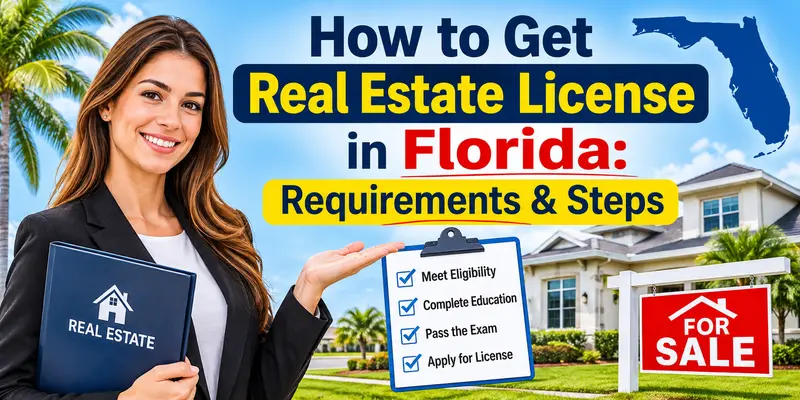
If you are wondering how to get real estate license in Florida, the process is relatively straightforward when you understand each requirement. The Florida Department of Business and Professional Regulation (DBPR) regulates real estate licensing, while the Florida Real Estate Commission (FREC) establishes educational and professional requirements.
This guide explains the Florida real estate licensing process, including eligibility, course requirements, application procedures, fingerprints, examination preparation, estimated costs, and license activation. It also includes practical examples to help beginners understand how to become a licensed real estate sales associate in Florida.
What Is a Real Estate License in Florida?
A Florida real estate license is an official authorization issued by the state that allows a qualified individual to perform specific real estate activities legally. These activities may include selling, buying, renting, leasing, advertising, and negotiating property transactions within the scope of the license.
In simple terms, a real estate license demonstrates that an individual has met the state’s educational, examination, background-check, and other eligibility requirements to work in the real estate profession.
The Florida real estate licensing system primarily distinguishes between sales associates and brokers. A sales associate works under the direction, control, or management of a licensed broker or an eligible owner-developer. A broker has additional qualifications and can operate a brokerage business and supervise sales associates.
For example, imagine that Sarah wants to help families purchase houses in Miami. She completes the required pre-licensing education, submits her application, passes the Florida state examination, and activates her license with a brokerage. She can then work as a licensed sales associate and assist clients with property transactions.
However, obtaining a real estate license does not automatically make someone a REALTOR®. The term REALTOR® refers to a real estate professional who is a member of the National Association of REALTORS® and follows its membership requirements and professional code of ethics.
To understand the broader property industry, you may also read our guide on Real Estate Meaning, which explains the definition, major property categories, and common real estate activities.
Florida Real Estate License Requirements
Before learning how to get real estate license in Florida, you should determine whether you meet the state’s basic eligibility conditions. Florida has established minimum requirements for individuals applying for a sales associate license.
According to the Florida DBPR and Florida Statutes, applicants generally must meet the following conditions:
| Requirement | Florida licensing condition |
|---|---|
| Minimum age | 18 years |
| Education | High school diploma or equivalent |
| Identification requirement | Valid U.S. Social Security number |
| Pre-license education | Approved 63-hour course |
| Background screening | Electronic fingerprints |
| Examination | Pass the Florida state examination |
| Application | Submit the appropriate DBPR application |
These requirements are based on the state’s official licensing guidance and Florida Statutes, Chapter 475. Checklist Details+1
Minimum age requirement: You must be at least 18 years old when applying for a Florida real estate sales associate license. Applicants who are younger than 18 do not qualify under the standard licensing requirements.
Educational qualification: You must possess a high school diploma or its equivalent. A college degree is not generally required to obtain an entry-level sales associate license.
Social Security number: Applicants must possess a U.S. Social Security number to apply for a Florida real estate license. This is an important requirement for individuals living outside the United States who are considering entering the Florida real estate market.
Good character: Florida law also establishes character and professional suitability requirements. Previous disciplinary or licensing issues may affect an application, depending on the circumstances.
Pre-license education: You must complete the approved 63-hour sales associate pre-licensing course before sitting for the state examination. The course completion remains valid for two years.
Therefore, meeting the basic eligibility requirements is the first step toward obtaining your professional license.
Step 1: Complete the 63-Hour Florida Real Estate Pre-License Course
The first major educational requirement is completing a Florida-approved 63-hour pre-license course for sales associates. This course introduces students to the fundamental principles, practices, laws, and regulations governing real estate transactions.
The Florida Real Estate Commission requires applicants to complete this education through an approved provider. You can generally choose between classroom-based instruction and approved online learning.
The course covers several important areas of real estate knowledge, including:
- Real estate principles and practices
- Property ownership and legal descriptions
- Real estate laws and regulations
- Contracts and agreements
- Property valuation and appraisal
- Real estate financing and mortgages
- Brokerage relationships
- Property management
- Real estate mathematics
- Professional responsibilities and ethics
The course also includes a required end-of-course examination.
For example, consider Michael, who wants to become a real estate sales associate in Orlando. He enrolls in an approved online Florida real estate course and studies property ownership, contracts, financing, and real estate law. After completing the required instruction and course examination, he receives proof of course completion.
He can then use this documentation to qualify for the state licensing examination.
How long does the 63-hour course take?
The actual completion time depends on the provider, learning format, and student’s schedule. Some students complete the course over several weeks, while others spread their studies over a longer period.
It is important to remember that the 63-hour course is a state requirement, not simply a recommended preparation program.
You can find approved educational providers through the Florida DBPR Real Estate Division. My Florida License+1
Step 2: Submit Your Florida Real Estate License Application
After understanding the educational requirements, the next step is submitting your application to the Florida Department of Business and Professional Regulation.
The relevant application for a new sales associate is known as DBPR RE 1 – Sales Associate Initial Application.
You can submit the application through the official online licensing system or use the available printable application.
The application process generally requires you to provide personal information, educational details, identification information, and other requested documentation.
When completing your application, make sure that:
- Your legal name and personal information are accurate.
- You provide the required Social Security number.
- You answer all background and disclosure questions truthfully.
- You select the correct license type.
- You pay the applicable application and licensing fees.
- You follow the department’s instructions for supporting documents.
One useful detail is that Florida allows applicants to submit their licensing application for examination approval before completing the 63-hour education course. However, the education requirement must be fulfilled before you can sit for the state examination.
You should carefully review the current application instructions because incomplete or incorrect information can delay the licensing process.
You can start the process through the official Florida DBPR Licensing Portal. The Sales Associate Initial Application Checklist provides the relevant application information. Checklist Details+1
Step 3: Complete the Required Fingerprinting and Background Check
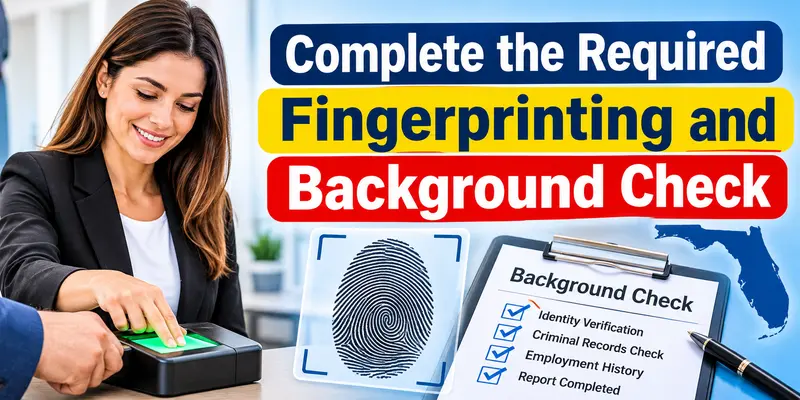
Another important requirement when learning how to get real estate license in Florida is completing the background screening process.
Florida requires applicants to submit electronic fingerprints so that the relevant authorities can conduct a criminal background check.
The fingerprinting process helps the licensing department evaluate an applicant’s professional suitability and determine whether any relevant criminal history or disciplinary matters require further review.
You must use a fingerprinting provider registered with the Florida Department of Law Enforcement (FDLE).
The general process involves:
- Submit your license application to DBPR.
- Locate an FDLE-registered Livescan fingerprinting provider.
- Schedule your fingerprinting appointment.
- Provide the required personal information and identification.
- Pay the fingerprinting service fee.
- Ensure that your fingerprints are submitted electronically for the Florida licensing background check.
According to the official DBPR checklist, applicants should submit fingerprints immediately after submitting their licensing application. Fingerprint results may take up to five days to reach the department after submission to FDLE.
It is also important to understand that having a previous criminal record does not necessarily mean every applicant will automatically be denied. The department evaluates relevant circumstances under applicable licensing laws and regulations.
For additional instructions, visit the official Florida DBPR Fingerprinting Information. Checklist Details+1
Step 4: Schedule and Pass the Florida Real Estate Exam
After meeting the education and application requirements and receiving authorization, you can schedule your Florida real estate sales associate examination.
The state examination is administered through Pearson VUE, the testing provider used by Florida for real estate licensing examinations.
The examination evaluates whether applicants understand the fundamental knowledge needed to perform real estate activities professionally.
Topics may include real estate principles, Florida real estate law, property ownership, contracts, financing, valuation, brokerage relationships, and other relevant subjects.
To prepare effectively, you should review your pre-license course materials, practice real estate mathematics, study Florida-specific regulations, and complete practice examinations.
What score do you need to pass?
The standard Florida Real Estate Sales Associate Examination requires a minimum passing score of 75 out of 100.
This means you must demonstrate sufficient knowledge of the tested subjects rather than simply memorize a few definitions.
For example, suppose Jennifer takes the examination and answers 78 questions correctly out of 100. She achieves the required passing score and can proceed with the remaining licensing steps.
However, if she scores 70, she does not pass and must follow the examination provider’s retake procedures.
The examination is generally administered as a computer-based test. You should check the latest candidate information booklet for the examination structure, duration, scheduling procedures, and testing policies.
You can visit the official Pearson VUE Florida Real Estate Examination page or the Florida DBPR Examination Information page to review the current arrangements. My Florida License+1
Step 5: Receive Your Florida Real Estate Sales Associate License
After successfully passing the state examination, your licensing application can move toward final approval.
The Florida DBPR reviews the examination results and other required information before issuing the license.
Once the licensing requirements are satisfied, you can check your license status through the official DBPR online system.
It is important to understand that receiving a license number and activating the license are two different things.
A newly issued sales associate license may initially have an inactive status. To perform licensed real estate activities, you must have the license activated under an eligible Florida real estate broker or owner-developer.
For example, David passes his state examination and receives his Florida sales associate license. However, he has not yet joined a brokerage. His license remains inactive until an eligible broker completes the activation process.
Therefore, obtaining the license is not necessarily the final step toward starting your professional career.
You can use the Florida DBPR Online Services portal to review your license information and applicable status.
Step 6: Find a Florida Real Estate Broker and Activate Your License
After passing the examination, the next important step is finding a licensed broker who can supervise your work as a sales associate.
Florida sales associates generally cannot independently operate as real estate brokers. They must work under the supervision and management of an eligible broker or owner-developer.
Choosing the right brokerage can influence your professional development, business opportunities, training, and potential income.
When comparing brokerages, consider:
- Training and mentorship programs
- Commission structures
- Office and transaction fees
- Marketing and advertising support
- Technology and listing tools
- Professional development opportunities
- Local market experience
- Company reputation
For example, a newly licensed sales associate in Tampa may join a residential brokerage that provides training, property listing tools, and mentorship from experienced agents.
Once the broker agrees to work with the sales associate, the broker can activate the license through the DBPR online system or the appropriate activation procedure.
You should confirm that the license displays the correct active status before performing activities that require an active license.
This distinction is particularly important for beginners who assume that passing the examination automatically allows them to begin representing buyers and sellers.
How Much Does It Cost to Get a Real Estate License in Florida?
The total cost of obtaining a Florida real estate license depends on the educational provider, application charges, fingerprinting services, examination fees, and other related expenses.
There is no single fixed total because course providers and service charges can differ.
The main expenses generally include:
| Expense | What it covers |
|---|---|
| Pre-license course | Approved 63-hour education |
| Application fee | Processing the DBPR application |
| License fee | Applicable state licensing charge |
| Fingerprinting | Electronic fingerprinting and background screening |
| Examination fee | Pearson VUE testing appointment |
| Additional study materials | Practice exams and preparation resources |
Pre-license course cost: Educational providers offer different course packages. Prices may vary according to whether you choose online learning, classroom instruction, additional study materials, or examination preparation.
Application and licensing fees: You must pay the applicable fees specified in the current DBPR application. Do not rely on older fee figures because state charges can change.
Fingerprinting cost: Livescan providers charge for electronic fingerprinting services. The amount depends on the provider and applicable processing charges.
Examination cost: Pearson VUE charges the applicable examination fee when you schedule your examination. Check the current candidate information booklet for the latest amount.
Additional expenses: Some students purchase practice examinations, flashcards, textbooks, or additional preparation resources to improve their chances of passing the examination.
For accurate costs, consult the Florida DBPR Licensing Portal and Pearson VUE before making payments.
How Long Does It Take to Get a Real Estate License in Florida?
The time required to obtain a Florida real estate license depends on how quickly you complete the educational course, application, fingerprinting, examination, and activation procedures.
Some applicants complete the process within a few weeks, while others may need several months because of their study schedules, application processing, or examination availability.
The following is an illustrative timeline:
| Licensing activity | Estimated time |
|---|---|
| Complete 63-hour course | 2–6 weeks |
| Submit application | 1–3 days |
| Fingerprinting and processing | Several days |
| Examination preparation | 1–3 weeks |
| Schedule and take examination | Depends on availability |
| Final licensing and activation | Depends on processing and broker |
These are planning estimates, not guaranteed DBPR processing times.
For example, a student who studies online regularly, completes the course quickly, submits the application correctly, and passes the examination on the first attempt may obtain a license faster than someone who studies part-time.
Therefore, if you are planning to enter the Florida property market, it is helpful to prepare your documents and educational schedule in advance.
Can You Get a Florida Real Estate License Online?
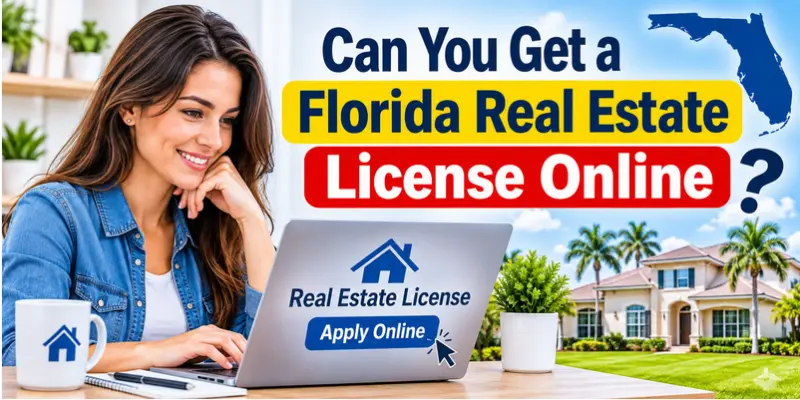
Yes. You can complete the required pre-license education through an approved online learning provider.
Online education is particularly useful for individuals who have full-time jobs, family responsibilities, or other commitments that make classroom attendance difficult.
However, there is an important distinction between completing the course online and obtaining the entire license online.
You may complete your education remotely, submit your application through the online DBPR portal, and arrange electronic fingerprinting. You must still complete the required state examination through the approved testing arrangements.
Before purchasing an online course, verify that the provider is approved by the Florida Real Estate Commission.
For example, someone living in Jacksonville can enroll in an approved online course, study at home, complete the required education, and subsequently arrange the state examination.
Online learning makes the educational part more flexible, but it does not remove the state’s licensing requirements.
Florida Real Estate Sales Associate vs. Real Estate Broker License
Understanding the difference between a sales associate and a broker is important because they have different responsibilities and qualification requirements.
A sales associate is generally an entry-level licensed real estate professional who works under the supervision of a broker. A broker has additional education and experience requirements and can operate a brokerage and supervise sales associates.
| Feature | Sales Associate | Real Estate Broker |
|---|---|---|
| Professional level | Entry-level | Advanced |
| Pre-license course | 63 hours | 72 hours |
| Experience | Not generally required | Generally 24 months of qualifying experience |
| Supervision | Works under a broker | Can supervise sales associates |
| Business operations | Cannot independently operate as a broker | Can operate a brokerage |
| Main responsibilities | Assist with property transactions | Manage brokerage and supervise transactions |
The broker education requirement is separate from the sales associate requirement. Florida generally requires qualifying applicants to have held an active sales associate license for at least 24 months during the preceding five years, subject to applicable alternative qualifications and exemptions.
For official information, see the Florida Real Estate Broker Requirements. myfloridalicense.custhelp.com+1
What Happens After Getting a Florida Real Estate License?
Obtaining and activating your license is the beginning of your real estate career, not the end of the professional development process.
Florida requires newly licensed sales associates to complete additional education during their initial licensing period.
According to the Florida Real Estate Commission’s educational requirements, sales associates must complete an approved 45-hour post-licensing course before their first license renewal.
After the initial renewal period, licensees generally need to complete 14 hours of continuing education during each subsequent two-year renewal period.
The continuing education requirement includes:
- 3 hours of Florida law core education
- 3 hours of ethics and business practices
- 8 hours of specialty continuing education
These requirements help real estate professionals remain informed about regulations, professional responsibilities, and industry practices.
You should always check the expiration date and education requirements associated with your individual license.
For more information, visit the Florida Real Estate Education Requirements. My Florida License+1
Can You Get a Florida Real Estate License If You Have a License From Another State?
Yes, under certain conditions. Florida has mutual recognition agreements with selected states that allow eligible nonresident real estate professionals to apply for an equivalent Florida license through a simplified process.
These agreements recognize certain qualifications and licensing experience obtained in participating states.
The states currently listed by the Florida DBPR include:
- Alabama
- Arkansas
- Connecticut
- Georgia
- Illinois
- Kentucky
- Mississippi
- Nebraska
- Rhode Island
However, mutual recognition is not automatic. Applicants must meet the applicable eligibility requirements, hold a qualifying current and active license in good standing, and satisfy the Florida-specific examination requirement.
The mutual recognition examination consists of 40 questions, and applicants must achieve at least 30 points to pass.
For example, a qualified real estate sales associate licensed in Georgia may apply for an equivalent Florida license under the applicable agreement without following the entire standard pre-license education route.
You can review the Florida DBPR Mutual Recognition Requirements before submitting an application. MyFloridaLicense.com+1
Can Foreigners or Nonresidents Get a Real Estate License in Florida?
Florida licensing requirements are particularly important for individuals who live outside the United States but want to enter the state’s real estate industry.
A nonresident may qualify for a Florida real estate license if they satisfy the applicable licensing requirements. However, the standard sales associate application requires a U.S. Social Security number.
This means that simply completing an online real estate course or passing an examination does not automatically make an international applicant eligible.
Applicants who already hold real estate licenses in other jurisdictions should also examine whether Florida’s mutual recognition or other licensing provisions apply to their circumstances.
If you live outside Florida, review the DBPR requirements carefully before spending money on educational courses or examination preparation.
Common Mistakes to Avoid When Applying for a Florida Real Estate License
Although the licensing process is straightforward, applicants sometimes make mistakes that delay their applications or prevent them from progressing to the examination stage.
Choosing an unapproved education provider: Not every online real estate course satisfies Florida’s licensing requirements. Always confirm that the provider is approved before enrolling.
Ignoring the two-year course validity period: Your completed 63-hour course is valid for two years for licensing purposes. If it expires before you take the state examination, you may need to repeat the education requirement.
Submitting incorrect application information: Errors in your legal name, personal information, or disclosure responses can create unnecessary processing delays.
Forgetting fingerprinting: Applicants must complete the required electronic fingerprinting and background screening. Submitting the application without arranging fingerprints can delay the process.
Preparing inadequately for the examination: Completing the course does not guarantee that you will pass the state examination. Practice tests, mathematics exercises, and Florida real estate law revision can improve your preparation.
Assuming the license is automatically active: Receiving your license does not necessarily mean you can immediately begin working independently. An eligible broker must activate your sales associate license.
Avoiding these mistakes can make the licensing process more efficient and help you begin your real estate career with fewer complications.
Tips for Successfully Starting Your Real Estate Career in Florida
After completing the licensing process, developing professional skills and building industry relationships can help you establish yourself in the competitive Florida property market.
Start by learning about your local market. Florida has different property markets, including Miami, Orlando, Tampa, Jacksonville, Fort Lauderdale, and other growing communities.
Understanding local property prices, buyer preferences, rental demand, and neighborhood developments can help you communicate more effectively with clients.
Next, develop your communication and negotiation skills. Real estate professionals regularly interact with buyers, sellers, property owners, lenders, and other industry participants.
You should also become familiar with property marketing. Online listings, professional photography, social media, property descriptions, and digital advertising can help you reach potential clients.
Another useful strategy is finding an experienced broker who offers professional guidance and mentorship. New sales associates can benefit from learning how experienced professionals manage client relationships, property transactions, and negotiations.
You may also explore the broader business side of the industry through our guide on What Is Real Estate Business?.
Finally, remember that professional development does not end after obtaining a license. Keeping up with Florida regulations, market conditions, technology, and continuing education can help you build a sustainable career.
Frequently Asked Questions About How to Get Real Estate License in Florida
1. How do I get a real estate license in Florida?
To obtain a Florida real estate sales associate license, you generally need to be at least 18 years old, have a high school diploma or equivalent, possess a U.S. Social Security number, complete the approved 63-hour pre-license course, submit the DBPR application, complete fingerprinting, and pass the state examination.
2. How much does it cost to get a real estate license in Florida?
The total cost depends on the education provider, state application and licensing fees, fingerprinting charges, and examination fees. Applicants should check the current DBPR and Pearson VUE fee schedules before beginning the process.
3. How long does it take to get a real estate license in Florida?
Many applicants can plan for approximately one to three months, depending on their study schedule, course completion, application processing, examination availability, and whether they pass on their first attempt.
4. Can I get a Florida real estate license online?
You can complete the required 63-hour pre-license course through an approved online provider and submit your application online. However, you must still complete fingerprinting and the required state examination.
5. Is a college degree required to become a real estate agent in Florida?
No. A college degree is not generally required for a standard sales associate license. Applicants must have a high school diploma or its equivalent and satisfy the other state licensing requirements.
6. Do I need a Social Security number to get a Florida real estate license?
Yes. The standard Florida real estate sales associate application requires a U.S. Social Security number.
7. What is the passing score for the Florida real estate exam?
The standard Florida sales associate examination requires a score of at least 75 out of 100 to pass.
8. Can I sell houses in Florida without a real estate license?
Activities that fall within Florida’s statutory definition of real estate brokerage generally require an appropriate license unless a specific legal exemption applies. You should not perform activities requiring a license without obtaining the appropriate authorization.
9. Do I need a broker to activate my Florida real estate license?
Generally, yes. A sales associate must be registered with an eligible broker or owner-developer to activate the license and perform activities requiring an active license.
10. Can I become a real estate broker directly in Florida?
Florida has specific experience and education requirements for broker applicants. The standard route generally requires at least 24 months of qualifying active sales associate experience during the preceding five years, together with the approved 72-hour broker pre-license course and other applicable requirements.
11. How long is the Florida real estate license valid?
An initial sales associate license generally has an initial renewal period of 18 to 24 months, depending on its issue date and expiration date. You must complete the required post-licensing education before the first renewal.
12. Is the Florida real estate license valid in other states?
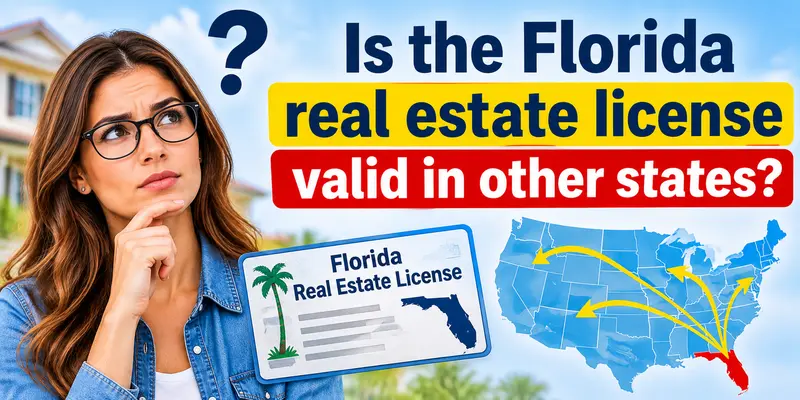
No. A Florida real estate license does not automatically authorize you to practice in every other state. Licensing requirements are determined by the relevant state’s real estate regulatory authority.
Conclusion
Obtaining a Florida real estate license can be an important first step toward building a professional career in the property industry. Although the process involves several requirements, understanding the correct sequence makes it easier to complete each stage successfully.
If you want to know how to get real estate license in Florida, begin by checking your eligibility, completing the approved 63-hour pre-license course, submitting the DBPR application, and arranging the required fingerprinting. After receiving examination approval, prepare carefully for the state examination and achieve the required passing score.
Once you pass, work with an eligible Florida broker to activate your license and begin your professional journey. Remember to complete the required post-licensing education and maintain your license through continuing education.
With proper preparation, professional guidance, and knowledge of Florida’s licensing regulations, you can take meaningful steps toward becoming a licensed real estate sales associate and developing a successful career in the Florida property market.
Disclaimer: This article provides general educational information, not legal or licensing advice. Florida licensing requirements, fees, and procedures may change. Always verify the latest requirements with the Florida Department of Business and Professional Regulation before applying.




- Be Respectful
- Stay Relevant
- Stay Positive
- True Feedback
- Encourage Discussion
- Avoid Spamming
- No Fake News
- Don't Copy-Paste
- No Personal Attacks
- Be Respectful
- Stay Relevant
- Stay Positive
- True Feedback
- Encourage Discussion
- Avoid Spamming
- No Fake News
- Don't Copy-Paste
- No Personal Attacks
