California Real Estate License: Requirements, Costs & Steps
Published: 15 Nov 2026
Getting a California real estate license can open the door to a rewarding career in one of the largest and most active property markets in the United States. Whether you want to help people purchase their first homes, represent property sellers, work with investors, or eventually establish your own real estate business, obtaining the appropriate license is an important first step.
California has specific education, examination, application, and fingerprinting requirements for individuals who want to work as real estate salespersons. The California Department of Real Estate (DRE) regulates licensing and ensures applicants meet the state’s professional and legal standards.
If you are considering a career in this field, understanding the licensing process before enrolling in a course can help you avoid unnecessary expenses and delays. You need to know which qualifications are required, how to complete the pre-licensing education, what the examination involves, and how much the entire process may cost.
This guide explains how to get a California real estate license, including eligibility requirements, required courses, examination procedures, application fees, fingerprinting, and license renewal. It also covers important questions about online education, nonresident applicants, and working with a sponsoring broker.
What Is a California Real Estate License?
A California real estate license is an official authorization issued by the California Department of Real Estate that allows qualified individuals to perform regulated real estate activities in the state.
A licensed real estate salesperson can assist clients with buying, selling, leasing, and other permitted real estate transactions while working under the supervision of a licensed real estate broker.
For example, a salesperson may help a homebuyer find suitable properties, arrange property showings, prepare transaction documents, communicate offers, and assist clients throughout the purchasing process.
A real estate license also establishes professional accountability. Licensees must follow California real estate laws, disclose relevant information, maintain ethical standards, and comply with applicable consumer protection requirements.
The California Department of Real Estate is the primary regulatory authority responsible for administering salesperson and broker licensing.
You can learn more about the profession in our guide to what a real estate agent is.
California Real Estate License Requirements
Before applying for a California real estate salesperson license, you must meet the state’s basic eligibility and education requirements.
The California Department of Real Estate establishes these requirements to ensure applicants have the necessary knowledge and qualifications before entering the profession.
1. Minimum Age Requirement
Applicants must be at least 18 years old to receive a California real estate license. Individuals younger than 18 cannot be issued a salesperson license, even if they have completed the required education.
2. Education Requirements
Applicants must successfully complete three college-level real estate courses before qualifying for the salesperson examination.
These courses include:
- Real Estate Principles
- Real Estate Practice
- One approved elective course
Each course must meet California’s college-level credit requirements or be completed through an appropriately approved private real estate school.
3. Honesty and Truthfulness
Applicants must demonstrate honesty and truthfulness. The DRE reviews relevant criminal history and other information when evaluating an application.
A criminal conviction does not automatically mean every applicant will be denied. However, certain convictions or failures to disclose required information may affect licensing eligibility.
4. Examination Requirement
Applicants must qualify for and pass the California real estate salesperson examination. Passing the examination is necessary before the DRE can issue the license.
5. Fingerprinting and Background Review
Applicants must submit fingerprints for a background check through the required process. The DRE reviews the results before issuing an original license.
6. Sponsoring Broker
A sponsoring broker is not necessarily required to obtain the salesperson license itself. However, a salesperson cannot perform activities requiring a real estate license without the appropriate responsible broker supervision.
For additional information, consult the official California DRE salesperson licensing requirements.
How to Get a California Real Estate License: Step-by-Step Process
Obtaining a California real estate license involves several stages, from completing the required education to passing the examination and receiving approval from the DRE.
Following the correct sequence can make the application process easier and help you avoid common mistakes.
Step 1: Confirm Your Eligibility
Start by checking whether you meet California’s minimum age and other licensing requirements.
You must be at least 18 years old and meet the applicable honesty and disclosure standards. You should also review the education requirements before enrolling in any real estate course.
If you have previously completed real estate education outside California, check whether those courses qualify under California’s rules.
Step 2: Complete the Three Required Real Estate Courses
The next step is completing the three required college-level courses.
The two mandatory subjects are Real Estate Principles and Real Estate Practice. You must also complete one approved elective.
California accepts qualifying courses from accredited institutions and private real estate schools approved by the Real Estate Commissioner.
Make sure your selected courses satisfy the state’s requirements. Not every online real estate course automatically qualifies for licensing purposes.
Step 3: Obtain Your Course Completion Records
After completing the required education, obtain official transcripts or acceptable course completion documentation.
You will need supporting documents when submitting your examination application.
Check that your name and other personal information are consistent across your educational records and application. Differences in names or missing documents may create processing delays.
Step 4: Prepare Your Examination Application
Once you have completed the education requirements, you can prepare your application for the California real estate salesperson examination.
Applicants may use the DRE’s online eLicensing system or submit the appropriate application by mail.
The combined Salesperson Exam/License Application, Form RE 435, allows eligible applicants to apply for the examination and original license together.
Read the instructions carefully and provide all required information.
Step 5: Submit Fingerprints
Fingerprinting is an important part of the licensing process.
California applicants generally use the Department of Justice Live Scan system. You must complete the Live Scan Service Request form (RE 237) and visit an authorized fingerprint service provider.
The fingerprints are submitted for the required state and federal background review.
The original license cannot be issued until the DRE receives and reviews the required fingerprint results.
Step 6: Schedule and Pass the California Real Estate Exam
After your application is processed and you qualify, you can schedule the salesperson examination.
The examination tests your understanding of real estate principles, property ownership, financing, contracts, agency relationships, disclosures, and California real estate law.
Prepare using the official examination content outline and suitable study materials.
Step 7: Complete the Final Licensing Requirements
After passing the examination, the DRE reviews the remaining licensing requirements, including your application and background check.
If you have not already submitted the necessary license application and fees, follow the DRE’s instructions to complete the process.
If you intend to work as a salesperson, arrange to associate with a licensed California real estate broker before conducting activities that require a license.
Step 8: Receive Your California Real Estate License
Once the DRE approves your application and all requirements are satisfied, your salesperson license can be issued.
You can use the DRE’s online license lookup and eLicensing services to check your license information and status.
Do not begin performing activities that require a license before your license has been issued and the appropriate broker supervision arrangements are in place.
What Are the Three Required California Real Estate Courses?
California requires three college-level courses for individuals seeking to qualify for the salesperson examination.
Each course provides knowledge that future real estate professionals need when assisting clients and handling property transactions.
1. Real Estate Principles
Real Estate Principles introduces the fundamental concepts of the real estate industry.
Students learn about property ownership, land rights, property interests, real estate markets, agency relationships, and the legal framework governing property transactions.
The course also introduces different types of real estate, ownership structures, and the responsibilities of real estate professionals.
2. Real Estate Practice
Real Estate Practice focuses on the practical activities involved in real estate transactions.
Topics generally include:
- Listing agreements and buyer representation
- Property marketing and advertising
- Real estate contracts
- Negotiation procedures
- Agency relationships
- Property disclosures
- Fair housing responsibilities
- Ethical professional conduct
California also requires qualifying Real Estate Practice courses to include components addressing implicit bias and fair housing. The fair housing component must include an interactive participatory element.
3. One Approved Elective Course

Applicants must complete one additional course from the DRE-approved elective subjects.
Eligible options include:
- Real Estate Appraisal
- Property Management
- Real Estate Finance
- Real Estate Economics
- Legal Aspects of Real Estate
- Real Estate Office Administration
- General Accounting
- Business Law
- Escrows
- Mortgage Loan Brokering and Lending
- Computer Applications in Real Estate
- Common Interest Developments
Choose an elective that supports your professional interests. For example, Real Estate Finance may be useful if you are interested in property financing, while Property Management may be more relevant if you want to manage rental properties.
Each course must meet the applicable college-level credit requirements, generally three semester units or four quarter units. DRE-approved private real estate courses have a minimum length of 45 hours.
How to Apply for a California Real Estate License Online
The California Department of Real Estate provides online services through its eLicensing system.
This system allows eligible applicants to submit licensing applications, make payments, and manage certain examination and license-related activities.
To apply online:
- Visit the official California DRE website.
- Open the eLicensing section.
- Create an account or sign in to your existing profile.
- Select the salesperson examination application.
- Enter the requested personal information.
- Upload the required education documents and supporting records.
- Follow the instructions for fingerprinting.
- Pay the applicable examination and licensing fees.
- Submit the application and retain your confirmation details.
You should review the application carefully before submitting it. Incorrect information, missing transcripts, or incomplete documentation may delay processing.
Applicants can also use the combined examination and license application when they meet the relevant requirements.
For the latest instructions, visit the DRE Salesperson Examination and License Application Process.
California Real Estate License Exam: Format, Questions and Passing Score
Passing the California real estate salesperson examination is one of the most important requirements for obtaining a license.
The examination evaluates whether applicants understand the legal, financial, ethical, and practical concepts involved in real estate transactions.
Examination Format
According to the California DRE, the salesperson examination has the following format:
- Total questions: 150
- Question type: Multiple choice
- Examination duration: 3 hours
- Passing score: At least 70%
The examination is designed to assess knowledge across several important real estate subjects.
Main Examination Topics
The examination covers areas such as:
- Property ownership and land use controls
- Laws of agency and fiduciary duties
- Property valuation and financial analysis
- Real estate financing
- Transfer of property
- Real estate practices and disclosures
- Contracts and transaction procedures
Among these topics, real estate practices and disclosures, agency relationships, and property ownership are particularly important areas to understand.
How to Prepare for the Examination
A structured study plan can help you prepare effectively.
Start by reviewing your three pre-licensing courses. Pay particular attention to California real estate law, agency duties, contracts, disclosures, and fair housing.
Practice multiple-choice questions to become familiar with the examination format. Review incorrect answers carefully so you understand the underlying concepts rather than memorizing answers.
You should also use the official DRE examination content outline to organize your preparation.
What Happens If You Fail?
If you do not pass the examination, you can apply for another attempt under the DRE’s examination rules.
You will generally need to pay the applicable re-examination fee and schedule another examination.
Avoid rushing into another attempt without reviewing the subjects where you had difficulty. Additional preparation can improve your understanding and confidence.
How Much Does a California Real Estate License Cost?
The total cost of obtaining a California real estate license depends on several factors, including course tuition, examination fees, fingerprinting, and licensing charges.
The official DRE fees are only part of the overall expense. Education providers may charge different amounts depending on the courses and study packages they offer.
Official California DRE Fees
The following table summarizes the principal salesperson licensing fees shown on the DRE fee schedule.
| Expense | Amount |
|---|---|
| Salesperson examination | $100 |
| Original salesperson license | $350 |
| Fingerprint processing | $49 |
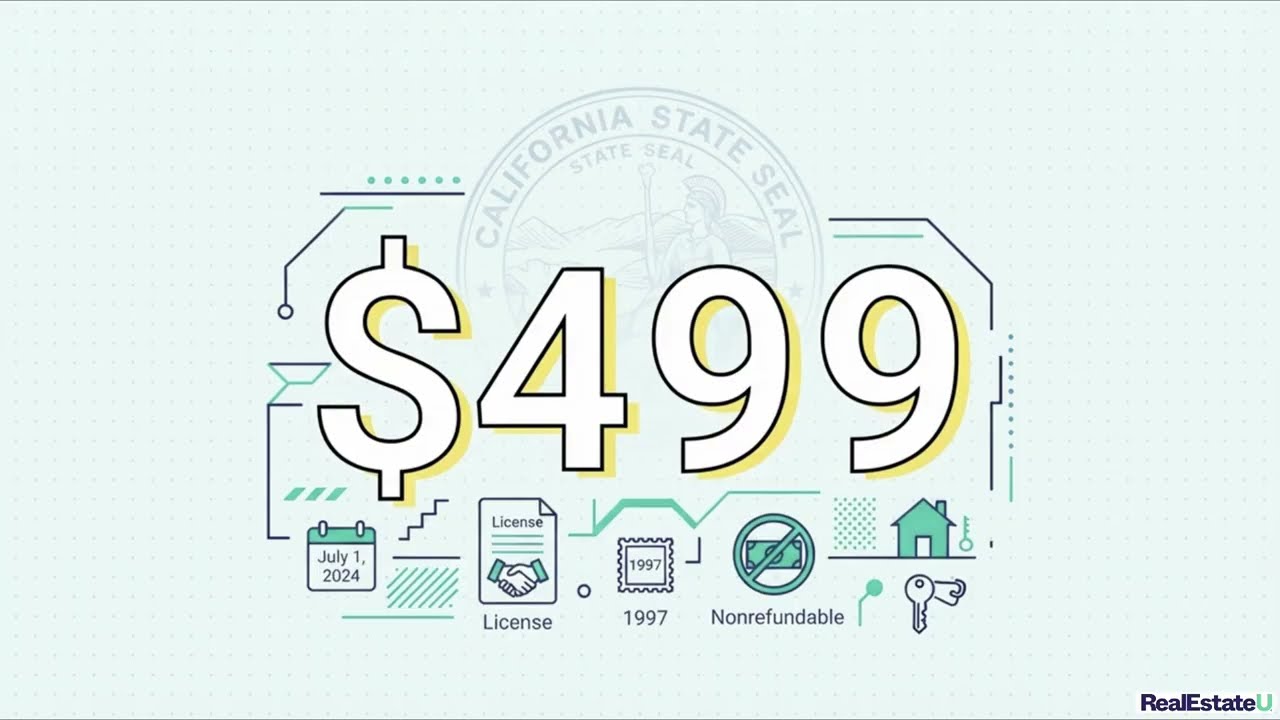
| Combined examination and license fees, including fingerprinting | $499 |
For California residents, the $49 fingerprint processing fee is generally paid directly to the Live Scan service provider. The $100 examination fee and $350 license fee total $450 payable to the DRE when using the combined application.
Therefore, the overall official fee amount for the combined process is $499, excluding any additional costs for education, preparation materials, travel, or other services.
Additional Education and Preparation Costs
Pre-licensing education is usually one of the major expenses.
The price depends on the institution, course delivery method, learning materials, and additional services included in a package.
You may encounter:
- Individual course tuition
- Complete three-course packages
- Online learning materials
- Examination preparation courses
- Practice examination subscriptions
- Additional tutoring or support
Some schools offer bundled packages, while others charge separately for each course.
Before enrolling, confirm that the provider’s courses are approved for California licensing purposes.
What Is the Total Estimated Cost?
There is no single total cost that applies to every applicant because education prices vary.
A useful way to calculate your budget is:
Total estimated cost = Required course tuition + DRE examination fee + Original license fee + Fingerprinting fee + Optional preparation expenses.
Remember that the official fee schedule can change. Always verify current charges directly through the California DRE fee schedule before submitting payment.
How Long Does It Take to Get a California Real Estate License?
The time required to obtain a California real estate license varies from one applicant to another.
Some applicants complete their education and examination preparation relatively quickly, while others need additional time because of work commitments, course schedules, examination availability, or application processing.
The main stages include:
Pre-Licensing Education: Completing three qualifying courses is a major part of the process. The time depends on your study schedule and the educational provider.
Application Processing: The DRE must receive and review the application and supporting documents. Processing times can vary depending on application volume and whether all documents are complete.
Examination Scheduling: The waiting period depends on available examination appointments and your preferred location.
Fingerprint and Background Review: Fingerprint processing and background review must be completed before the original license can be issued.
For this reason, it is better not to rely on a fixed number of days as a guaranteed licensing timeline. Plan ahead and check the DRE’s current processing information.
Can You Get a California Real Estate License Online?
Yes. Applicants can complete qualifying pre-licensing education through approved online education providers.
Online courses are particularly useful for people who work full-time, have family responsibilities, or prefer studying at their own pace.
However, not every online course qualifies for California licensing.
Before purchasing a course, check that the provider and its specific courses meet the DRE’s education requirements.
You should also understand that completing online education does not mean the entire licensing process is online. Applicants must still satisfy the examination, fingerprinting, application, and other applicable requirements.
What to Look for in an Online Real Estate School
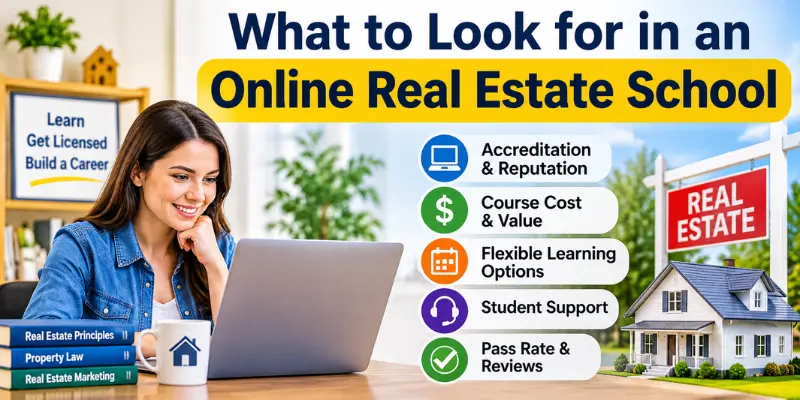
When comparing California real estate schools, consider:
- DRE approval for the required courses
- Course completion requirements
- Availability of instructor assistance
- Learning materials and practice examinations
- Flexible study schedules
- Total tuition and additional charges
- Refund and cancellation policies
Do not select a provider solely because it advertises the lowest price or a high examination pass rate. Verify that the courses satisfy California’s statutory requirements.
Best California Real Estate Schools: What Should You Consider?
Choosing a suitable real estate school can make your preparation more organized and convenient.
California has several educational providers offering salesperson pre-licensing courses and examination preparation.
Some providers appearing in the real estate education market include Kaplan, Colibri Real Estate, and Allied Schools.
However, applicants should verify the approval status of the exact courses they intend to purchase rather than relying only on the reputation of a school.
Kaplan Real Estate Education
Kaplan offers real estate education products and licensing-related courses. Applicants should check its California-specific course offerings and confirm that the selected package covers all three required subjects.
Colibri Real Estate
Colibri provides online real estate education and learning resources. It may be worth comparing its California course options, available support, and examination preparation materials.
Allied Schools
Allied Schools offers California real estate licensing education. Prospective students should review its current course packages, pricing, and included study resources.
How to Choose the Right School
Before making a decision, compare at least two or three providers.
Check the total cost of completing all three required courses, not just the advertised introductory price. Also review course access periods, completion documentation, instructor support, and refund conditions.
You can verify approved education providers through the California DRE education resources.
California Real Estate Salesperson vs. Broker License
California has different licensing requirements for real estate salespersons and brokers.
Understanding the distinction is important because both licenses involve different levels of education, experience, and professional responsibility.
Real Estate Salesperson License
A salesperson license allows an individual to perform authorized real estate activities under the supervision of a licensed broker.
Salespersons commonly work with residential buyers, sellers, landlords, and property investors.
They may assist with property listings, showings, negotiations, contracts, and other permitted activities.
Real Estate Broker License
A real estate broker license provides broader professional authority.
A broker who meets the applicable requirements can operate an independent brokerage, supervise salespersons, and conduct authorized real estate activities.
California generally requires broker applicants to meet additional education and experience requirements.
Key Differences
| Feature | Salesperson | Broker |
|---|---|---|
| Education | Three qualifying courses | Eight statutory courses or applicable alternatives |
| Examination | Salesperson examination | Broker examination |
| Supervision | Works under a responsible broker | May operate a brokerage |
| Professional responsibility | Works within broker supervision | May supervise salespersons |
| Career options | Salesperson roles | Brokerage and management opportunities |
A salesperson who gains the required experience and education may later consider applying for a broker license.
For a more detailed explanation, see our guide to what a real estate broker does.
Can Nonresidents Get a California Real Estate License?
Yes. California does not require every real estate license applicant to be a California resident.
Applicants who live in other US states may apply if they satisfy California’s licensing requirements.
However, California does not offer reciprocity with other states that automatically waives its licensing requirements.
This means an existing real estate license from another state does not automatically authorize someone to practice real estate in California.
Out-of-state applicants must still qualify for the appropriate California examination and meet the applicable education and licensing requirements.
They may also have additional documentation responsibilities.
For example, nonresident applicants must submit the required Consent to Service of Process form (RE 234). Out-of-state fingerprinting procedures may also differ from those used by California residents.
Applicants who intend to conduct real estate business in California must follow the applicable broker affiliation requirements.
For official guidance, consult the DRE’s Out-of-State Applicants information.
How to Renew a California Real Estate License
Obtaining your license is only the beginning of your professional responsibilities. California real estate licensees must also meet renewal requirements to maintain an active license.
A California real estate license is generally issued for four years.
Salespersons and brokers must complete the required continuing education before renewal, unless a specific exemption applies.
Continuing Education Requirements
For a first-time salesperson renewal, California generally requires 45 clock hours of approved continuing education.
The required subjects include ethics, agency, trust fund handling, risk management, fair housing, and implicit bias training, together with the required consumer protection and other qualifying courses.
For subsequent renewals, licensees must also complete 45 hours of approved continuing education under the applicable requirements.
Renewal Process
You can generally renew your license through the DRE’s online eLicensing system.
The process includes:
- Check your license expiration date.
- Complete the required continuing education.
- Gather the course completion information.
- Log in to the DRE eLicensing system.
- Complete the renewal application.
- Pay the applicable renewal fee.
- Confirm your renewed license status.
Salesperson renewal fees are currently $350 for an on-time renewal and $525 for a late renewal within the permitted late-renewal period.
A license may generally be renewed late within two years after its expiration date, subject to the applicable requirements. However, you cannot conduct activities requiring an active real estate license while it remains expired.
For complete details, visit the official California DRE license renewal information.
Common Mistakes to Avoid When Applying for a California Real Estate License
Although California provides a structured licensing process, applicants sometimes make mistakes that create unnecessary delays or additional expenses.
Understanding these issues before starting can make the process smoother.
1. Choosing a Non-Approved Education Provider
One common mistake is purchasing an online course without checking whether it satisfies California’s requirements.
Always verify the provider and specific course approval before paying tuition.
2. Completing the Wrong Courses
California requires Real Estate Principles, Real Estate Practice, and one approved elective.
Completing unrelated real estate training does not automatically satisfy these requirements.
3. Submitting Incomplete Documents
Missing transcripts, inconsistent personal information, and incomplete application forms can delay processing.
Review all documentation before submitting your application.
4. Ignoring Fingerprinting Requirements
Some applicants assume that passing the examination is the final requirement.
However, the original license cannot be issued until the required fingerprint results have been received and reviewed.
5. Underestimating the Total Cost
The examination and licensing fees are only part of the expense.
Remember to include course tuition, fingerprint processing, and optional examination preparation when planning your budget.
6. Assuming Another State’s License Automatically Transfers
California does not provide automatic real estate license reciprocity with other states.
Applicants who already hold a license elsewhere must review California’s specific requirements.
7. Working Without Proper Broker Supervision
A salesperson cannot independently perform licensed activities without the appropriate responsible broker supervision.
Make sure your professional arrangements comply with California law before accepting clients or conducting transactions.
Career Opportunities After Getting a California Real Estate License
A California real estate salesperson license can provide access to several career opportunities in the property industry.
The type of work you pursue may depend on your interests, experience, professional network, and brokerage.
Residential Real Estate
Residential salespersons help individuals and families purchase or sell houses, condominiums, townhomes, and other residential properties.
This area may suit professionals who enjoy working directly with homebuyers and sellers.
Commercial Real Estate
Commercial real estate involves properties used for business purposes, including offices, retail spaces, warehouses, and industrial buildings.
Salespersons interested in this field may develop specialized knowledge of commercial property markets and investment transactions.
Property Investment
Some licensed professionals work with investors who are interested in purchasing rental properties, residential developments, or other income-producing real estate.
Understanding property valuation, financing, and market conditions can be valuable in this area.
Property Management
Real estate professionals may also develop careers involving property management, depending on the activities performed and applicable licensing requirements.
For readers interested in the wider industry, our guides on starting a real estate business and becoming a real estate agent provide additional information.
Frequently Asked Questions About California Real Estate Licenses
1. How do I get a California real estate license?
To obtain a California real estate salesperson license, you must be at least 18 years old, complete three qualifying college-level real estate courses, qualify for and pass the state examination, submit fingerprints, and satisfy the DRE’s application requirements.
2. How much does a California real estate license cost?
The official combined salesperson examination, original license, and fingerprinting costs total approximately $499 under the current DRE fee schedule. Education tuition and other optional expenses are additional.
3. How many courses are required for a California real estate license?
California requires three qualifying college-level courses: Real Estate Principles, Real Estate Practice, and one approved elective.
4. How many questions are on the California real estate exam?
The salesperson examination contains 150 multiple-choice questions and has a three-hour time limit. Applicants must correctly answer at least 70% of the questions to pass.
5. Can I get a California real estate license without a college degree?
Yes. A traditional college degree is not required. However, applicants must complete the three required college-level real estate courses or meet an applicable statutory exemption.
6. Can I complete my California real estate courses online?
Yes. You can complete qualifying pre-licensing education online through an appropriately approved provider. However, the examination, fingerprinting, and other licensing requirements must still be satisfied.
7. Does California offer real estate license reciprocity with other states?
No. California does not offer reciprocity that automatically waives its real estate licensing requirements. Applicants licensed in another state must still meet California’s applicable requirements.
8. Do I need a sponsoring broker to get a California real estate license?
A sponsoring broker is not necessarily required for the issuance of the salesperson license. However, you must work under the supervision of a licensed responsible broker before performing activities that require a real estate license.
9. How long is a California real estate license valid?

A California real estate license is generally valid for four years. Licensees must complete the applicable continuing education and renewal requirements to maintain their licenses.
10. Can I become a California real estate broker after obtaining a salesperson license?
Yes. A salesperson may pursue a broker license after meeting California’s additional education, experience, and examination requirements.
Conclusion
Obtaining a California real estate license can be an important step toward building a professional career in the state’s property market. Although the process requires preparation, education, examination, and documentation, understanding each requirement makes it easier to plan your next move.
Start by confirming your eligibility and completing the three required college-level courses. Next, prepare your application, satisfy fingerprinting requirements, and pass the California salesperson examination. Once the DRE approves your application and issues your license, you can begin working under the supervision of a licensed responsible broker.
Remember that licensing is an ongoing professional responsibility. You must follow California real estate laws, maintain ethical standards, complete continuing education, and renew your license on time.
Before submitting an application or paying for a course, always verify the latest requirements and fees through the California Department of Real Estate. Doing so can help you avoid unnecessary expenses and begin your real estate career with greater confidence.






- Be Respectful
- Stay Relevant
- Stay Positive
- True Feedback
- Encourage Discussion
- Avoid Spamming
- No Fake News
- Don't Copy-Paste
- No Personal Attacks
- Be Respectful
- Stay Relevant
- Stay Positive
- True Feedback
- Encourage Discussion
- Avoid Spamming
- No Fake News
- Don't Copy-Paste
- No Personal Attacks
